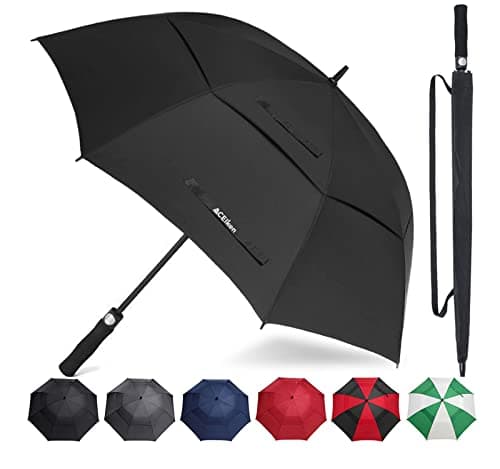
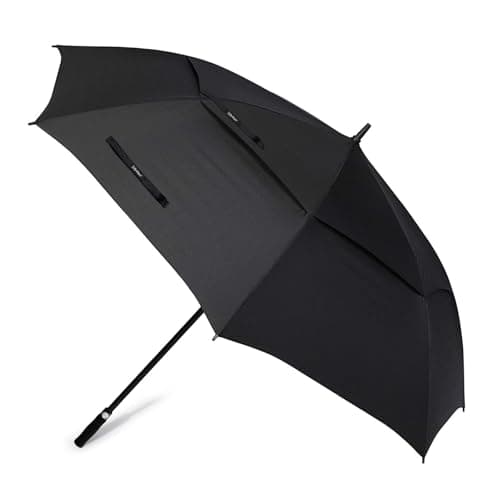
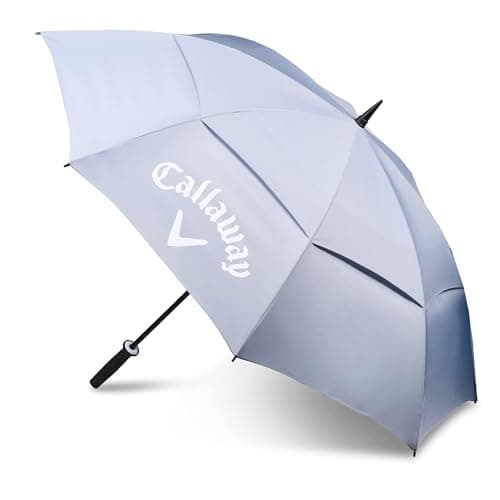
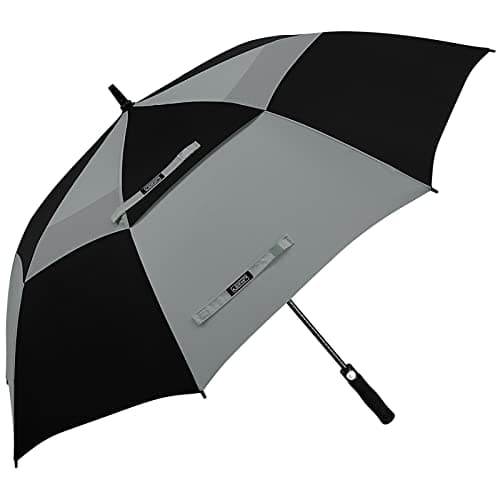
The G4Free 62-inch is the best golf umbrella for the money — a vented double canopy on fiberglass ribs, for around a quarter of what the tour brands charge. Go to the 72-inch version if you share it or push a cart, and to the Callaway only if you want something that will survive five seasons rather than two.
The two features that decide whether an umbrella survives
Golf umbrellas fail in exactly two ways: they invert in a gust, or a rib snaps. Both failures have a known engineering fix, and both fixes are available at the bottom of the price range.
- A vented double canopy. Two layers of fabric with a gap between them. Wind passing under the canopy escapes through the vent instead of building pressure and flipping it. This is the single most important feature, and it is on every umbrella here.
- Fiberglass ribs. Fiberglass flexes under load and springs back. Steel ribs bend permanently, and cheap aluminum ones snap. If a listing does not say fiberglass, assume it is not.
That is the whole specification. Everything else — the logo, the handle material, the fabric coating — changes how the umbrella feels, not whether it works.
What size do you actually need?
Golf umbrellas are sold by arc, which is the measurement across the curved canopy rather than straight across the ground. It is a bigger number than the usable coverage, which is why a 62-inch umbrella covers a lot less than 62 inches of ground.
- 62 inches. Covers one golfer and a bag. The right size for a walker, and it fits most stand-bag umbrella sleeves.
- 68 to 72 inches. Covers two people, or one person plus a push cart handle. Heavier, and it will not fit in most bag sleeves.
- Under 60 inches. A rain umbrella, not a golf umbrella. It will not cover your bag, which is half the job.
Automatic open, manual close — and why nobody makes it automatic both ways
Every umbrella on this page opens at the push of a button and closes by hand. That is not a cost saving; it is a design decision. An auto-close mechanism needs a strong spring that has to be reset by force, and on an umbrella this size the resulting collapse is genuinely hazardous to fingers. Manual close is the correct engineering, and it is what the expensive tour umbrellas do too.
Where the branded umbrellas earn their money, and where they do not
They do earn it on frame quality. A Callaway or Titleist umbrella has thicker ribs, better finished joints and a shaft that will not bend when you lean on it as a walking stick. Over five seasons that is a real difference, and if you keep umbrellas rather than losing them, it is a defensible purchase.
They do not earn it on wet-weather performance. A vented double canopy on fiberglass ribs works the same whether it cost $25 or $70, and in the specific gust that inverts a cheap umbrella, the expensive one is usually inverting too. You are buying longevity, not dryness.
There is also a blunt behavioral argument. Everyone eventually leaves an umbrella on a cart or in a clubhouse stand. Losing a $25 umbrella is an inconvenience; losing a $70 one is annoying for a week.
Care, because it is the cheapest thing you can do
The one habit that doubles umbrella life: never put it away wet and folded. Open it indoors, let it dry, then furl it. A folded wet canopy grows mildew along the seams, the fabric coating breaks down, and the ribs corrode where the fabric holds moisture against them. That is how most golf umbrellas actually die — not in a storm, but in a bag pocket.
What we would actually buy
A walker who carries: the G4Free 62-inch, in the bag sleeve, permanently. A golfer who rides or pushes a cart, or plays with a partner who forgets theirs: the 72-inch. Someone who has owned the same golf umbrella for a decade and intends to keep doing that: the Callaway. And in every case, buy the vented double canopy — the un-vented single-layer umbrellas that cost five dollars less are the ones you will replace this season.
The rest of the wet-weather kit is on our rain gear roundup, and the bag that has to carry all of it is on our value bags page.