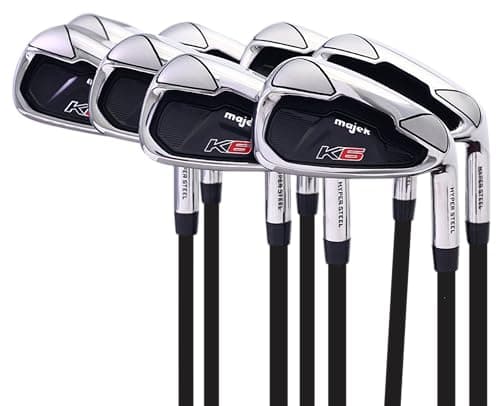
The Majek K6 is the best set of irons a senior can buy for the money — eight clubs designed around a slower swing from the start, in senior A-flex graphite, at a price the big brands charge for one iron. If your long irons have stopped getting airborne altogether, the Orlimar Stratos replaces them with hybrids instead of trying to rescue them. And if you want a branded set on a shaft you can look up the specification for, the Tour Edge Hot Launch Max is catalogued in senior flex and still costs less than a current flagship.
A note on the prices below. Complete-set and club prices on Amazon swing widely with third-party sellers — the live number on each card is today's, stamped with the date we checked it. If a set looks overpriced, it usually is, and it tends to come back down; it's also often cheaper in-store or direct. Treat the live price as a starting point and shop it around before you buy.
What actually changes when your swing slows down
Almost everything written about senior golf clubs starts in the wrong place, with the head. The head is not what changed about your golf. What changed is clubhead speed, and every consequence follows from that one number.
A slower swing produces less ball speed, which is the part everyone notices, but it also produces a lower launch angle and less spin — and those two are what actually cost you the shot. A ball that leaves the face too low and without enough spin to hold its height falls out of the sky early and runs out on landing, which is why a 6-iron that used to hold a green now releases over the back of it. The distance loss is real; the loss of the ability to stop the ball is what wrecks scores.
So a senior iron is not a weaker iron. It is one engineered to put launch back: weight pushed as low and as deep in the head as the construction allows, a sole wide enough that a slightly fat strike skids rather than digs, and a shaft light enough that you can still deliver the head with some speed. None of those three things is expensive to build. That is the whole reason this page exists — the features a senior needs are value features, and the features that cost flagship money are the ones a senior gets the least out of.
How we picked
Six criteria, applied in this order. We do not run a testing lab, so every judgment below comes from published manufacturer specification, independent robot-tested data we name, and the live retail listing — never from our own testing, because we have not done any.
- A senior flex that actually exists.Every set on this page was checked as available, today, in a senior or A flex in a right-handed men's build. That sounds like a low bar. It is not: a great many "best irons for seniors" lists recommend sets whose senior configuration is out of stock, left-hand only, or was never catalogued at all.
- Shaft weight and honesty about it.Graphite in the fifty-to-sixty gram range is the point of a senior build. A set that publishes its shaft — brand, model, weight, torque — is a set you can fit yourself into. A set that says only "graphite" is asking you to guess.
- Launch construction. Hollow bodies, deep undercut cavities and wide variable soles are all solving the same problem: getting weight low and deep so the ball climbs without help from you. We favored sets that state which of these they use.
- Set makeup. Seven clubs and eight clubs are not the same purchase, and whether the sand wedge or gap wedge is included changes what you still have to buy. Price per club is the only fair comparison.
- Length options. Senior golfers are not one height. A brand that sells short, standard and plus-one-inch builds is doing more for your ball striking than any face technology on this page.
- Availability today. Every set here was verified live and purchasable before it went on the page, and the price on each card is pulled from the retailer rather than typed in by us.
Senior flex is not a label, it is a weight and a bend point
The letter on the shaft — A, or sometimes M for mature, or just "senior" — is not standardized between manufacturers. One company's A flex is another company's regular. What is not arbitrary is the two numbers underneath it: how much the shaft weighs, and where along its length it bends.
Weight is the one that matters most and the one nobody talks about. A steel iron shaft typically runs somewhere near a hundred grams or more; the graphite shafts in the sets on this page run around fifty-five to seventy. That difference, multiplied across seven or eight clubs, is the reason a senior set feels like it swings itself, and it is why the last few holes of a walking round stop being an endurance test. Lighter also means faster for the same effort, and faster is the one thing you cannot buy back any other way.
Bend point is the second number. A senior-flex shaft bends lower down, closer to the head, which kicks the face upward through impact and adds launch angle. That is a direct fix for the low, spinless flight a slowing swing produces. It is also why putting a senior shaft in a swing that is still fast is a mistake — you get ballooning flight, lost distance, and a face that arrives closed.
Work from real clubhead speed rather than from your age. As a rough guide, a driver clubhead speed under about 75 mph wants a ladies or senior flex, 75 to 85 mph is squarely senior territory, 85 to 95 mph is regular, and above that you are into stiff. Most driving ranges with a launch monitor will give you the number in ten minutes, and it is the single most useful ten minutes in this whole process. Our shaft flex guide walks through the decision in full, and steel versus graphite covers the material side of it.
The two ways to make a long iron easy — and which one you want
Every set on this page is trying to solve the same problem, which is that a 4-iron and a 5-iron are close to unhittable for a slow swing. There are two engineering answers, and the right one for you depends on how bad the problem has actually got.
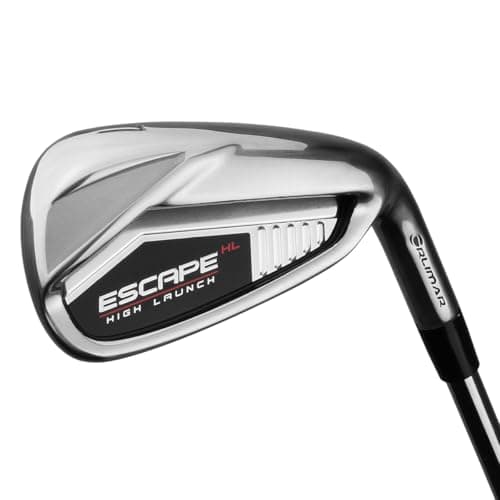
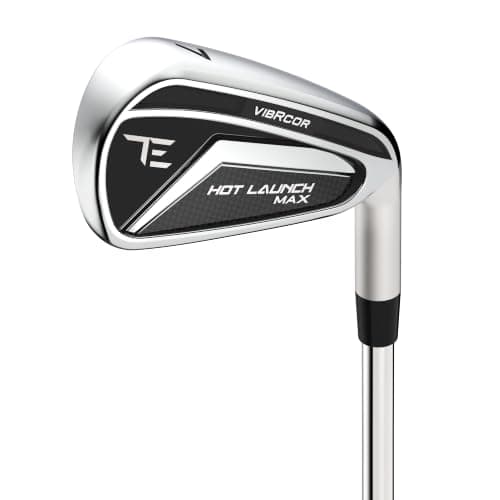
The first answer is a hollow body. The head is a shell rather than a solid lump, which frees the designer to move the mass low and deep behind the face and to make the face thin enough to flex. The club still looks like an iron, sits like an iron, and behaves like an iron out of the rough — it is just far more forgiving of a strike that lands low on the face, which is the miss a slow swing makes most. The Orlimar Escape HL and the Tour Edge Hot Launch Max are both built this way, and Tour Edge publishes the recipe: a 431 stainless hollow body with a deep 360-degree undercut cavity.
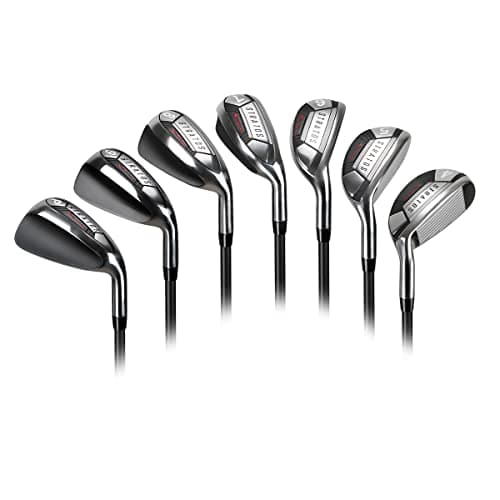
The second answer is a hybrid-iron. Instead of improving the long iron, you replace it: the 4-, 5- and 6-iron become small hybrid heads on iron-length shafts, and only the scoring clubs keep a conventional iron shape. This launches higher than any hollow iron can and is dramatically easier to hit off a tight lie. The trade is control. A hybrid head sits taller, comes out of thick rough less predictably, and gives you less ability to flight the ball down into wind. The Orlimar Stratos is the hybrid-iron option here, and the set that most seniors who have genuinely lost their long irons should be looking at.
If you are not sure which camp you are in, the test is simple and takes one range basket: hit ten 5-irons and count how many got properly airborne. Seven or more, buy the hollow body and keep the shot control. Three or fewer, stop trying to save the long iron and buy the hybrid set. Our hybrids for the money page covers the same swap one club at a time if you would rather not replace the whole set.
Why Orlimar appears twice
Two of the five picks here carry the same badge, which is worth explaining rather than hiding. Orlimar is one of a small number of brands that builds both answers above and catalogues both in senior flex, which is rarer than it should be. The Escape HL is the hollow-body iron set; the Stratos is the hybrid-iron set. They are not two versions of the same club, they are the two different solutions, and putting only one of them on the page would have meant leaving out a genuine option for the reader.
The honest caveat that comes with it: Orlimar sells direct and through discounters, so the same set can carry noticeably different prices in the same week. Check the live number on the card, then check it again somewhere else before you commit. That is true of every club in this category and is the reason we do not print prices in the text.
What a senior set does not need to buy
Three things get sold hard to older golfers and are worth almost nothing to them.
Forged heads. Forging buys feedback — the ability to feel precisely where on the face you struck it. That is useful information for a golfer whose strike pattern is already tight enough to act on it. For everyone else it is a premium paid for commentary, and forged sets are almost never offered in senior flex anyway. The full argument is on our irons for mid handicappers page.
Strong lofts. Every game-improvement iron built in the last decade has stronger lofts than the set it replaced, and manufacturers do it because bigger distance numbers sell clubs. For a senior it can actively hurt: a stronger loft launches lower, and launch is the exact thing you are short of. Compare lofts rather than the numbers stamped on the sole — the sets on this page publish theirs, which is part of why they are here.
This year's model. Iron technology moves slowly and iron pricing moves fast. A past-season set is the same club with a different year on the box, and the discount is real money. The same logic runs through buying used golf clubs, one step further down the depreciation curve.
What we would actually buy
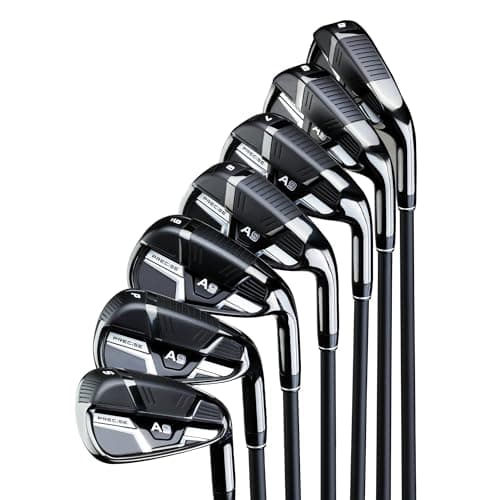
A senior replacing a tired steel set and wanting the most clubs for the least money: the Majek K6, in the length build that matches your height rather than the standard one. A golfer whose long irons still work but whose mishits have got expensive: the Orlimar Escape HL. A golfer who has genuinely stopped hitting anything longer than a 7-iron: the Orlimar Stratos, without hesitation. Somebody who wants to find out whether senior flex helps before committing real money: the Precise A9, which puts a named Project X Cypher shaft under you for the price of a bad round of green fees. And a senior who is buying one last set and wants it to be a proper branded one: the Tour Edge Hot Launch Max, which is the only club on this page with a specified Aldila shaft and a dealer network behind it.
Whatever you pick, spend the money you saved on the two things that outrank every head on this page: a lesson, and a ball matched to a slower swing. Our best golf balls for seniors ranking covers the second one, and it costs a fraction of what an iron set does. Spend where it matters.