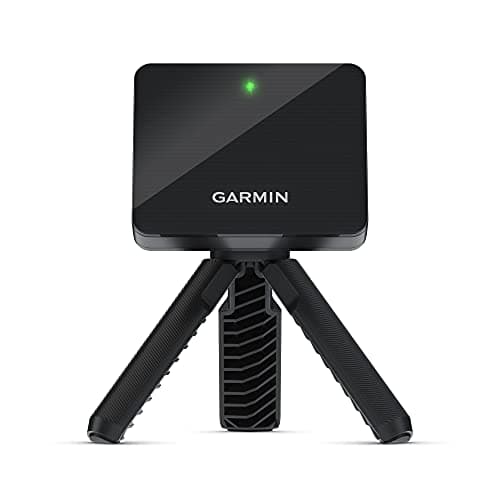
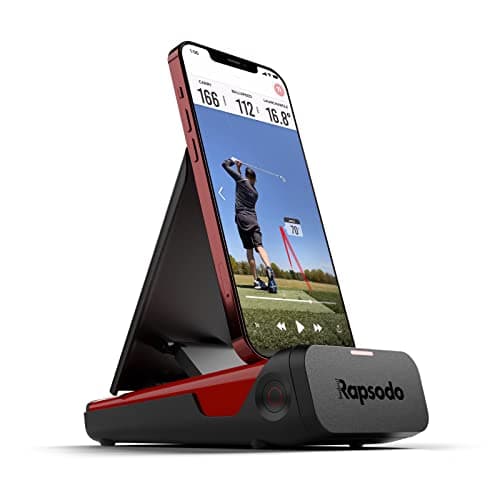
Buy the Rapsodo MLM if you own an iPhone or iPad and your goal is to learn your real carry distances for the least money. Buy the Garmin Approach R10 if you want spin data without special golf balls, a unit that works on Android as well as iOS, and the option of playing virtual courses indoors. They sit roughly in the $200 and $500 brackets respectively, and the gap buys more than most people assume — but less than the metric counts imply.
Both of these appear on our best launch monitors for the moneyroundup, where neither finished first. That is not a contradiction: the roundup answers "what should I buy at each price", and this page answers the narrower question people actually type, which is whether the Garmin's extra three hundred dollars does anything for a golfer who mostly wants to stop guessing with a 7-iron.
Measured versus estimated — the distinction that matters
Every launch monitor at this price measures some values directly and derives the rest. That is not a scandal; it is how the technology works. It does, however, decide what you can trust.
Rapsodo is unusually candid about it. Their own product page lists eleven metrics but labels five of them — ball speed, club speed, launch angle, launch direction and smash factor — as measured, with the rest derived. It also states the unit is iOS compatible only, iPhone or iPad required, and that spin rate requires Titleist RCT balls. If you want spin from a Rapsodo MLM, you are buying specific golf balls to get it.
Garmin's published specification for the R10 lists a longer parameter set: club head speed, club face angle, club path, angle of attack, ball speed, launch angle, launch direction, spin rate, spin axis, apex height, smash factor, and carry, total and deviation distance. It quotes accuracy of about one mile per hour on ball speed and three on club head speed. Spin comes off the radar rather than off a marked ball, which is the single biggest practical difference between the two units.
So the metric count is not the story. The story is that the Garmin gives you a plausible spin number with a normal golf ball and the Rapsodo does not, and that both give you a ball speed and a carry number you can build a practice session around.
The subscriptions nobody puts on the box
This is where the real price lives, and it is the part of the comparison most reviews skip.
- Rapsodo Premiumis listed on Rapsodo's site at $99.99 a year, and it is what unlocks the parts people think they are buying: shot storage and video (up to 10,000 shots), slow-motion playback, the shot trace and apex overlay, the Rapsodo Combine, Insights and R-Speed. A premium trial is included with the unit. Without it you still get your numbers; you lose most of the library and the tracer.
- Garmin Golf's paid membershipis what unlocks Home Tee Hero and virtual rounds on Garmin's 42,000-plus courses. Garmin's own specification sheet states that those features require an active subscription. The raw launch data does not.
Read it as a two-line budget rather than one price tag. If the thing you want is a simulator in the garage, the Garmin plus a membership is the honest cost of entry and it is a long way past five hundred dollars once you add a net and a mat — see our nets and mats roundup for what that actually runs. If the thing you want is to find out whether your 7-iron goes 150 or 138, the Rapsodo with no subscription does that on day one.
Where each one is clearly better
The Rapsodo MLM is better on value, and only on value — which is the axis this site cares about most. It is less than half the price, it needs no special setup beyond a phone on a stand, and the numbers it measures are the numbers a mid-handicapper will act on. The video with your swing next to the ball flight is genuinely useful for the range. If you have an iPhone, the barrier to entry is almost nothing.
The Garmin Approach R10 is the better machine. More parameters, radar spin without marked balls, a rechargeable battery rated at up to ten hours, Android and iOS support, and a path into simulator software. If you are going to practice indoors through a winter, it is the one that will still be interesting in March.
The honest limits of both
Neither of these is a launch monitor in the sense a fitter means it. At this price, spin is either derived or dependent on special balls, dispersion is approximate, and indoor use needs more space behind and in front of the ball than most garages want to give. Both will tell you your carry distances, show you a trend, and catch a gross swing fault. Neither should be used to argue with a fitting bay.
The other shared limit is behavioral, and it is the one that decides whether you wasted the money. A launch monitor only pays you back if you use it to build a yardage book and then practice to it. Our guide on whether cheap golf simulators are worth it is the sober read before you spend anything here.
Which one to buy
- Buy the Rapsodo MLM if you have an iPhone or iPad, you want your real distances, and you do not care about spin numbers or virtual golf. It is the cheapest credible answer to the most useful question.
- Buy the Garmin Approach R10 if you want spin with ordinary balls, you use Android, or indoor simulator play is part of the plan. Budget the membership alongside it.
- Buy neither if you have not yet bought a rangefinder or a GPS watch. Knowing the distance to the pin on the course beats knowing your launch angle at home, and it costs less — our budget rangefinder roundup is the better first purchase.