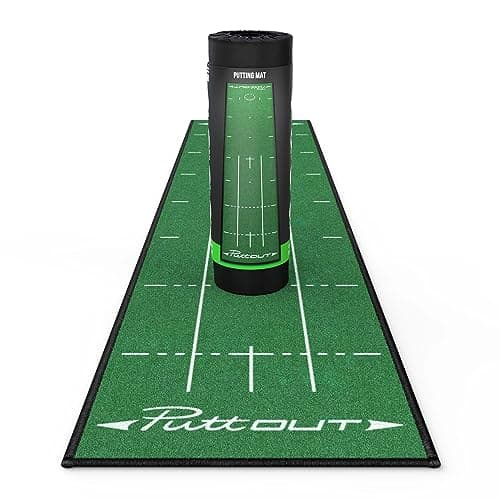
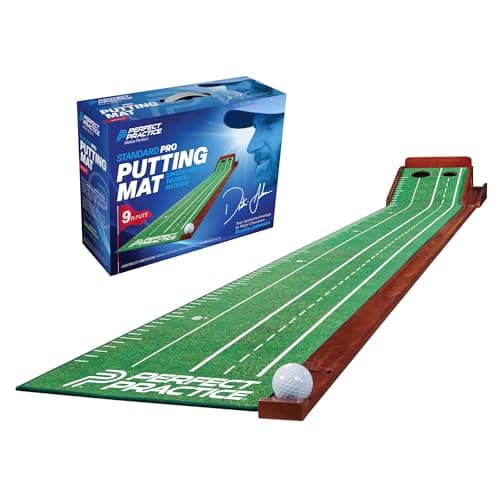
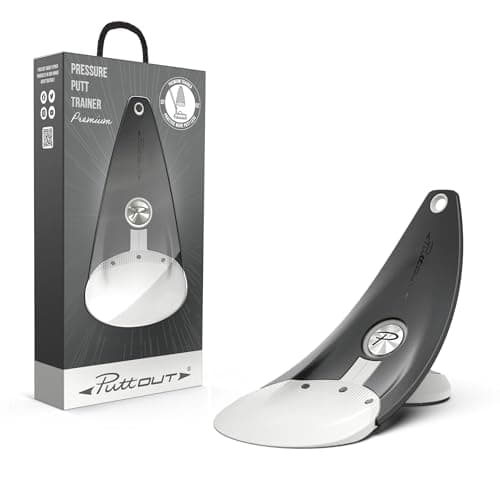
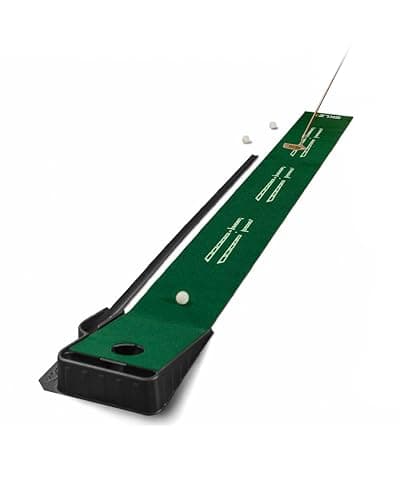
The SKLZ Accelerator Pro is the putting mat most golfers should buy — a nine-foot true-roll lane with a gravity ball return and alignment guides at 3, 5 and 7 feet, for about what a dozen premium balls cost. If you want a surface that matches a real green's speed on paper, the PuttOUT Medium publishes a stimp of 10 and pairs with the PuttOUT Pressure Putt Trainer, the thirty-dollar ramp that trains pace as well as line. And if you have the floor and the budget, the Perfect Practice Standard is the most complete home green under our price ceiling.
Why the putting mat is the most honest purchase in golf
Every other page in this hub asks you to spend money on a gadget that measures something. This one asks you to spend money on a strip of carpet, and it is the purchase we are most confident will lower your score. The reason is arithmetic. Around 40 percent of the strokes in an amateur round are putts, and most of the putts an amateur wastes are wasted on speed rather than line — the three-footer left after a lag that came up a yard short, the four-footer left after one that ran a yard past. Speed control is trained by repetition on a consistent surface, and a mat is the only consistent surface most golfers have access to on a Tuesday night.
The second reason is the one we keep coming back to on our training-aids page: a practice tool is only worth what you use it for. A hitting net needs a garage and a ceiling. A simulator needs a room and an evening. A putting mat needs a hallway and four minutes, which is why it has the highest completion rate of anything we recommend. The mat that lives unrolled by the television gets a hundred putts a week; the one in the closet gets none.
That also explains the price ceiling on this page. Nothing here costs more than a mid-range rangefinder, and most of it costs a lot less. Past that line you are no longer buying a mat, you are buying a putting green — a room-sized installation with contour and a dozen holes — and a room-sized installation is a different decision for a different reader.
How we picked
Six criteria, applied in this order. We do not own a Stimpmeter and we have not rolled a ball on any of these in a lab, so every speed, dimension and feature below is the manufacturer's published claim or the live listing, quoted as such. Where a maker publishes nothing, the pick says so in its cons.
- A published roll speed, or an honest silence. A mat's only real spec is how fast a ball rolls on it. PuttOUT and Wellputt print a Stimpmeter number and Perfect Practice prints a range; SKLZ and Putt-A-Bout say "similar to a green" and leave it there. We ranked the mats that tell you above the ones that do not, but we did not exclude a mat for silence when the rest of the package earns its place.
- A backing that keeps it flat. A crease in a mat is a break that does not exist on the course, and a mat that creeps on hardwood is a mat you stop using. Every mat here has a rubber or non-skid backing and a stated way of storing it flat.
- A target that gives feedback. A hole tells you whether the ball went in. A ball-return tells you nothing more but keeps you putting. A ramp like the PuttOUT tells you how hard you hit it. We weighted feedback over convenience, which is why a thirty-dollar ramp made the page and several sixty-dollar mats with a bare hole did not.
- A footprint you will leave out. Eight to ten feet long and a foot and a half wide fits a hallway or the side of a living room. Thirteen-foot mats and three-foot wide greens exist and we considered them; a mat that only fits when the furniture moves is a mat that gets rolled up.
- Verified in stock, at a live price. Every pick was checked against the Amazon catalog on the day this page was written, with a title matching brand and model, a real image and an in-stock offer. The number on each card is today's, not ours.
- Nothing above the price ceiling. The most expensive thing on this page costs about what a rangefinder under $200 does, and it is there because its drill program earns it. A mat priced like a putter had better putt for you.
Speed: what a stimp number actually tells you
A Stimpmeter is a grooved ramp. Release a ball from a fixed point and measure how far it rolls on a flat piece of green; that distance, in feet, is the green's speed. The USGA scale that courses quote runs slow under 8 feet, medium from 8 to 10, fast from 10 to 12 and very fast above that. A typical public course rolls its greens around 9 to 10 on a normal day and nudges them to 10 or 11 for a tournament. The tour greens you see on television are faster still, and they are not the ones you play.
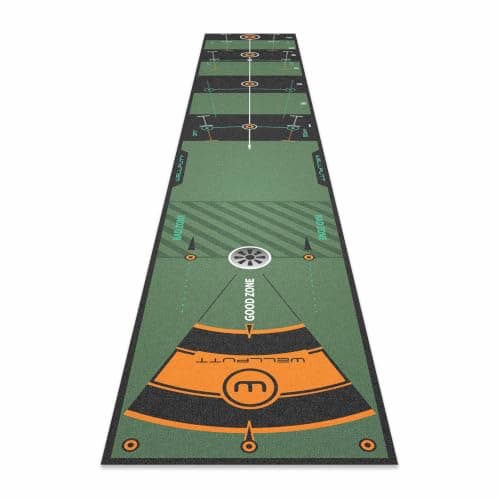
That frames the mats. The PuttOUT Medium publishes a 10, which is the top of medium — a weekday green at a decent public course, and the most useful single speed for an amateur to practice on. Wellputt builds two speeds into one strip: 10 in one direction for distance control and 11.5 in the other for accuracy work, which is a genuine feature if you use both and a curiosity if you do not. Perfect Practice publishes 10 to 14 depending on the floor beneath the mat, and that range is worth a moment's thought, because a mat that is medium on carpet and very fast on hardwood is really two different mats depending on the room. SKLZ and Putt-A-Bout publish no number at all.
Two things follow. First, do not pay extra for a mat because it is "tour speed"; training on a 13 when you play on a 9 teaches you to baby the putt on Saturday. Second, if you buy a mat with a published range, lay it on the same floor every time. Consistency is the entire point, and a mat you move from carpet to tile has thrown that away.
Length: why 8 to 10 feet is the useful range
The putts that decide an amateur's score are not the twenty-footers. They are the ones inside ten feet: the second putt after a lag, the par save after a chip, the four-footer the whole match rides on. Those are the putts a mat can train, because they are the ones where a repeatable stroke and a consistent pace do most of the work. Nine feet of true roll gives you every one of them and still fits down a hallway.
Longer mats exist — Wellputt sells a 13-footer, and Perfect Practice sells bundles that stretch the lane — and they are not wrong, they are just answering a question most golfers do not have. Lag putting is trained better on a real green, where the ball has forty feet to run out and the surface is not perfectly flat. A mat that runs past ten feet mostly buys you a mat that does not fit, and a mat that does not fit does not get used.
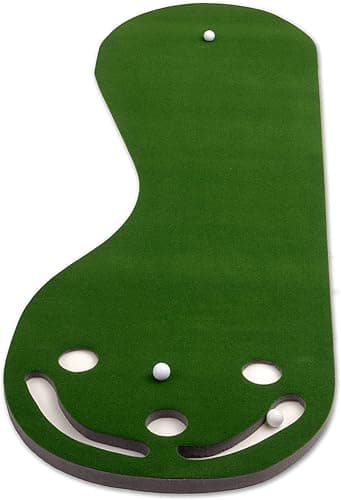
Width is the quieter number. Most mats here are a lane — 16 to 20 inches across — which is exactly enough for a straight putt and nothing more. The Putt-A-Bout is three feet wide, and that width is the reason it is on the page: you can putt at an angle, from two spots, or with someone else, and it is the only pick that allows any of that. The trade is that it gives you no feedback at all, which is the next section.
The three kinds of target, and what each one trains
Every mat on this page ends in one of three things, and which one you choose matters more than the turf.
- A hole. The Putt-A-Bout has three of them and the Perfect Practice has two. A hole tells you whether the ball went in and nothing else — a putt that drops at dying pace and a putt that slams the back of the cup both count as made, and only one of them would have gone in on a real green with a real slope. The Perfect Practice's reduced hole partly fixes this by shrinking the target, which is why it is the mat with a following.
- A ball return. The SKLZ and the Perfect Practice have one. It adds no information, but it removes the one thing that stops people practicing, which is walking nine feet to fetch a ball. On a mat that lives in a hallway, a return is worth more than a better surface, because it is the difference between twenty putts and a hundred.
- A ramp. The PuttOUT Pressure Putt Trainer is a parabolic ramp instead of a hole. PuttOUT states that a made putt rolls back to you the same distance it would have run past a real cup, and that the micro-target in the ramp only holds a putt struck at the pace that would finish 18 inches past the hole. That is the one target on this page that reports pace, not just line, and pace is where amateurs lose the strokes. It is not a mat — you put it on one — which is why it is ranked last and recommended first.
What a putting mat does not need to cost money for
The category has picked up the same expensive habits as the rest of golf, and most of them are worth skipping.
- Sensors and screens. Mats with built-in launch sensors and phone apps that score your stroke exist at several times the price of anything here. The feedback a ramp gives you — it came back, it stuck, it ran past — is the feedback that matters, and it costs thirty dollars.
- "Tour" turf. A premium surface is a real upgrade from carpet-fuzz, and the crystal velvet on the Perfect Practice or the pile-cut nylon on the PuttOUT are genuinely better than a bargain mat. Past that tier, the difference is marketing. You are practicing a stroke, not reading grain.
- Length past ten feet. Covered above. Buy the length that fits the room you will actually use it in.
- A better putter to roll on it. The mat comes first. Our budget putter roundup says the same thing from the other side: ten minutes on a mat three times a week does more for your speed control than any head shape, and the whole setup costs less than the premium putter on that page.
What we would actually buy
Most golfers, and anyone buying their first mat: the SKLZ Accelerator Pro, unrolled in a hallway and left there. It has the ball return that keeps you putting, the guides that keep you square, and it costs what it should. Add the PuttOUT Pressure Putt Trainer on top of it the month after, when you have proven to yourself that the mat gets used.
A golfer who wants the surface to match the course on paper: the PuttOUT Medium with the Pressure Putt Trainer on the end of it — a published stimp of 10 and a target that reports pace, for about what the SKLZ and the trainer cost together. A golfer with ten clear feet and a real intention to practice: the Perfect Practice Standard, for the two holes. A golfer who will follow a program: the Wellputt, and only that golfer. Anyone who wants the cheapest possible hole to putt at, and knows that is all they are getting: the Putt-A-Bout.
Roll a real ball on it. A range ball or a scuffed lake ball skids differently from the ball you play, and the whole point is a repeatable roll. A sleeve of the value ball you actually game is the right thing to keep by the mat.