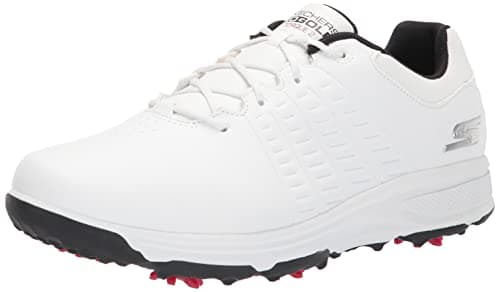
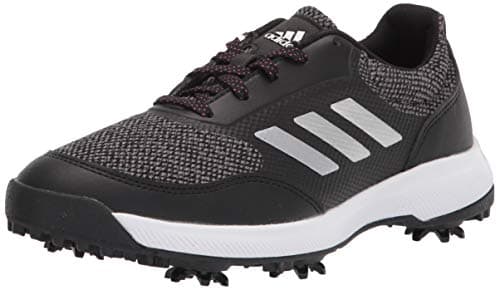
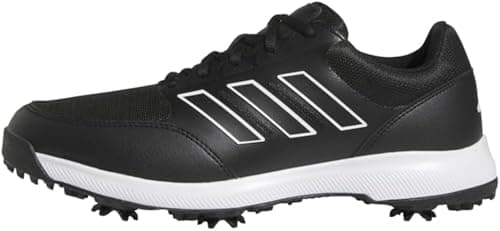
The adidas Tech Response 3.0 is the spiked shoe to buy: soft spikes, a traditional golf-shoe last and real lateral stability from a major brand, at the bottom of the price range. It is also our budget pick for men — the cheapest spiked shoe here. If you want the same traction with sneaker cushioning and a waterproof upper, the Skechers Go Golf Torque Pro is the upgrade. For women, the adidas Women's Tech Response 2.0 is the only shoe on this page whose listing publishes replaceable spikes and a one-year waterproof warranty.
Our hub already has a best budget spikeless golf shoes page and a spiked vs spikeless guide, and that guide ends by telling a certain kind of golfer to buy spikes. Until now it had nowhere to send them. This is that page, and the field is deliberately short: of the eleven golf shoes in our catalog, three publish spikes.
What spikes actually do, and when it matters
A spiked sole works by penetration. Six to nine small cleats dig into turf and resist lateral movement at the moment in the downswing when your trail foot is pushing hardest against the ground. A spikeless sole works by surface area — dozens of molded nubs pressing down rather than biting in.
On dry, firm fairways the difference is close to nothing, which is why spikeless took over. Three situations reverse it completely:
- Wet turf. Water between a flat nub and wet grass is a lubricant. A cleat goes through it.
- Sloping lies. Ball above or below your feet is where a slip costs you a shot, and it is exactly where penetration beats surface area.
- A fast swing. The more ground force you generate, the more traction you need to hold. This is why tour fields are still overwhelmingly spiked.
If you play mostly in summer, ride a cart and want to wear the shoes to lunch, the spikeless page is the right page. If you walk in the morning dew, play in spring and autumn, or swing hard, keep reading.
The spec that separates these three: can you replace the cleats?
This is the question listings bury. A shoe with replaceable soft spikes screws into threaded receptacles in the sole, so when the cleats wear you spend a few dollars on a new set and the shoe is as good as new. A shoe with moldedtraction cannot be renewed — when the grip goes, the shoe goes.
Of our three, the adidas Women's Tech Response 2.0 listing states replaceable spikes outright. The men's Tech Response 3.0 and the Skechers Torque Pro both specify soft spikes without stating the attachment, so check the sole in the photos before you buy and assume nothing. We are not going to tell you a shoe has threaded receptacles because it probably does.
How often should you change them? Bunkered, quoting Softspikes' own product manager, puts the general rule at every 15 to 20 rounds — about twice a season — and faster if you walk cart paths or dry hardpan, which grinds cleats down without any turf to cushion them. GolfNewsNet argues that interval is conservative and nearer once a season for most golfers. Either way, the honest version is this: almost nobody changes them at all, and a worn spike gives you the weight penalty of a spiked shoe with the traction of a tired spikeless one.
How we picked these
We do not run a lab, we have not measured ground force, and no shoe here was tested on a slope by us. We read what each listing publishes — spike type, upper material, waterproofing claim and warranty — and ranked on how much of that is checkable. Our methodology page states the rule.
- Published spike type. Soft spikes at minimum; replaceable if the maker says so. Metal spikes are banned at most courses and are not in our catalog.
- A waterproofing claim with a term attached.“Waterproof” with a one-year warranty behind it is a specification. “Water resistant” is a hope.
- Lateral stability over cushioning. A spiked shoe exists to hold the ground. If you wanted maximum cushioning you would buy the spikeless walking pick.
- Price, because this is a consumable. Golf shoes are replaced on a two-to-three year cycle, and our how long do golf shoes last page explains why spending $200 on them rarely pays back.
Published specs, side by side
Live prices for each shoe, with a per-row buy link and the date each price was checked, are in the Quick Picks table above.
| Shoe | Spikes | Waterproof claim | Fit |
|---|
| adidas Tech Response 3.0 | Soft spikes (attachment not published) | None published | Traditional golf-shoe last |
| Skechers Go Golf Torque Pro | Soft spikes (attachment not published) | Waterproof | Sneaker-like, cushioned |
| adidas Women's Tech Response 2.0 | Replaceable spikes | One-year waterproof warranty | Women's last, Bounce midsole |
What we are not ranking, and why
No metal-spike shoe, because most courses prohibit them and our catalog does not carry one. No hybrid shoe sold as “cleated” without naming the cleat type — that is a molded sole with marketing on it. And no shoe whose only traction claim is a photograph. If a category gap stays empty on this page, it is because nothing we could verify fits it, not because we ran out of room.
One more honest note: if you have wide feet, width availability matters more than spike type, and our best golf shoes for wide feet page covers which of these actually come in a wide fit. And if you walk every round, read best golf shoes for walkingfirst — cushioning may matter to you more than grip does.
Landed on spikes? Our best spiked golf shoes page ranks the three spiked shoes we carry and flags which listing actually publishes replaceable cleats.
Walking wet mornings or swinging hard enough to slip? Our best spiked golf shoes page is the other half of this choice, and it covers how often replaceable cleats need changing.
Shopping to a hard number instead? Our best golf gloves under $25 page ranks the field on cost per glove rather than sticker price, which changes the answer once multipacks are in the comparison.
The cheapest version of this decision is to own both. Our best golf gloves under $25page sets out the two-glove system — a dry-weather multipack plus one wet-weather glove — for less than a single premium leather glove costs.