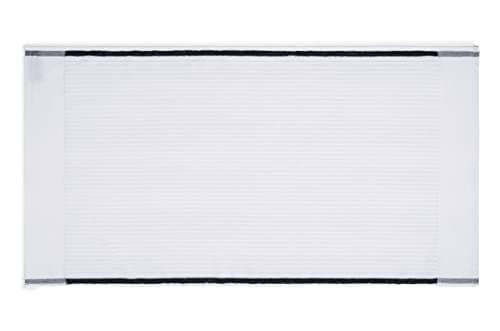
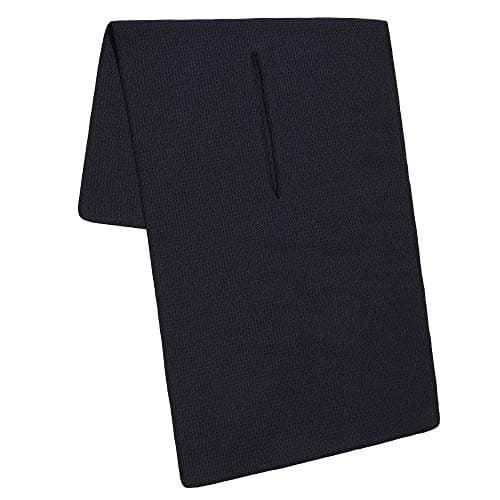
Buy a 17 x 40 inch waffle microfiber towel with a center slit, and buy a cheap one. You need the size so that half of it can be wet and half of it stays dry, and you need the texture because a flat towel smears mud around a groove instead of lifting it out. If you ride a cart, a magnetic towel with a small wet pocket is the better shape. Either way, the thing you are solving for is not softness. It is getting the clubface clean and dry before you hit it.
Nobody shops for a golf towel. It gets thrown in a cart at checkout, used until it is permanently gray, and replaced when someone gives you one with a logo on it. That is a shame, because this is one of the few accessories where the published research says the product actually affects the shot — and it says it loudly enough that we built this whole page around it.
The research that decides this category
Plugged In Golf's wedge-wear test is the most useful data anybody has published on what a clubface condition does to a shot. The headline finding everyone quotes is about groove wear: three new Cleveland RTX-3 wedges, worn with a thousand pitches, a thousand full swings and a thousand bunker shots, and dry performance was virtually unchanged. Grooves, it turns out, are tougher than the marketing suggests.
The finding nobody quotes is the one that matters here. In that same testing, a brand-new wedge lost roughly 30% of its full-swing spin from a single spray of water on the face, and wet-face spin across the worn wedges came in 5–20% down on dry. Not a worn face. A new one, wet.
Read that next to the towel in your bag. By the fourth hole on a dewy morning, most golfers are carrying one towel that is uniformly damp, and they are using it to wipe the face before a wedge shot. That action is not neutral — it leaves a film of water exactly where the spin comes from. A towel that cannot finish the job dry is actively costing you the thing you bought the wedge for. Our guide to how long golf clubs last runs the full version of that wedge research, including why regripping beats replacing a head.
How we ranked these
We do not run a lab and we have not weighed water absorption on a scale. What we did is take the wet-face finding above as the job the product has to do, then read what each listing actually publishes — dimensions, fabric, texture, attachment — and rank on how well the design serves two zones rather than one. Where a listing makes a performance claim with no test behind it, we say so instead of repeating it. Our methodology page states the rule plainly.
- Can it be wet and dry at the same time? Either by size (a big towel folded in half), by construction (two layers), or by a dedicated wet pocket. This is the whole ballgame.
- Texture, not plushness.A waffle grid gives the cloth edges that lift dirt out of a groove. A flat terry face pushes it along. Non-abrasive matters too — you are wiping a painted crown and a soft forged face.
- Dry time. Microfiber over cotton, every time, for the half of the towel that has to stay dry.
- Attachment. A center slit for bag carriers, a clip or magnet for cart riders. The failure mode is a towel on the ground, and a towel on the ground is a towel full of grit.
- Cost per towel. The honest truth is you want two or three, not one, and the cheapest sets make that trivial.
Waffle microfiber, flat microfiber, terry cotton
Three fabrics, three different products:
- Waffle microfiber. The default and the right answer for most people. The raised grid gives you thousands of small edges that scrape a groove, while the synthetic fiber wicks water and releases it fast. Every listing in this category claims it removes dirt better than cotton; that claim is at least mechanically sensible, which is more than most product claims manage.
- Flat microfiber. Softer, better for a lens or a glasses cloth, worse at mud. Fine as the dry half of a two-towel system.
- Terry cotton.Holds the most water of anything here, which sounds like a feature and is mostly a bug. Terry soaks, stays soaked, and takes hours to dry. Titleist's Players Terry towel states maximum absorption terry material and 20 x 40 inches, and it is genuinely the most cloth on this page — it is also the slowest to come back from wet.
One real advantage cotton has: Titleist specifies its towel as bleed-free. That is not marketing fluff. A wet, dark, cheap towel pressed against a white ball or a pale grip can transfer dye, and nobody else on this page says a word about it.
The wet/dry problem, and the three ways to solve it
Once you accept that you need wet cloth and dry cloth, the category sorts itself into three answers at three prices.
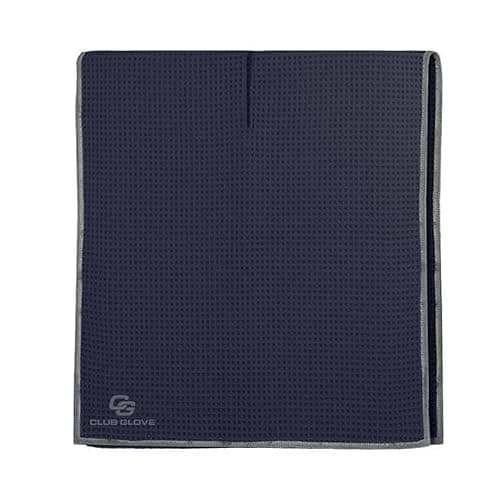
Buy one big towel and fold it.Seventeen by forty inches is the caddie standard for a reason — it is enough cloth that you can soak one end at the water fountain, keep the other end dry, and know which is which. Both our budget winner and the Club Glove towel publish exactly that size, with a waffle texture and a center slit. On paper they are the same towel. One of them costs considerably more than the other, and the difference you are buying is build quality and a name, not specification.
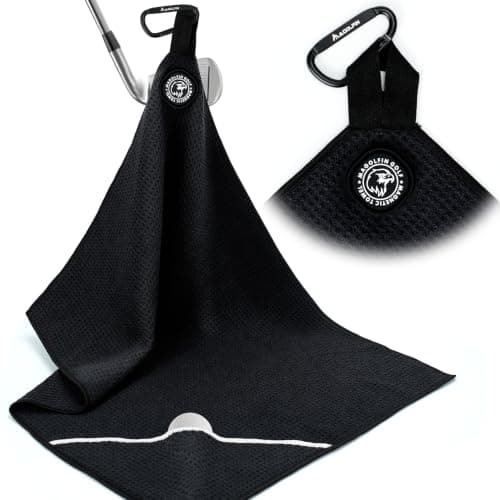
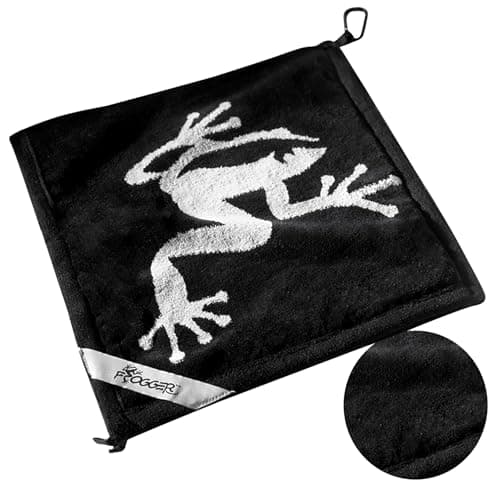
Buy a towel with the zones built in.Frogger's Amphibian is the design that defined this idea: an absorbent inner layer you wet at the start of the round and a separate dry exterior for drying gear. Frogger publishes the fabrics outright — a 100% cotton exterior over a 100% viscose-from-bamboo interior — which is both admirable and a caveat, because neither of those is microfiber and both dry slower than it. The cheaper version of the same idea is a waffle microfiber towel with a sewn-in wet pocket, which is what the magnetic pick here does with an 8 x 8 inch interior panel.
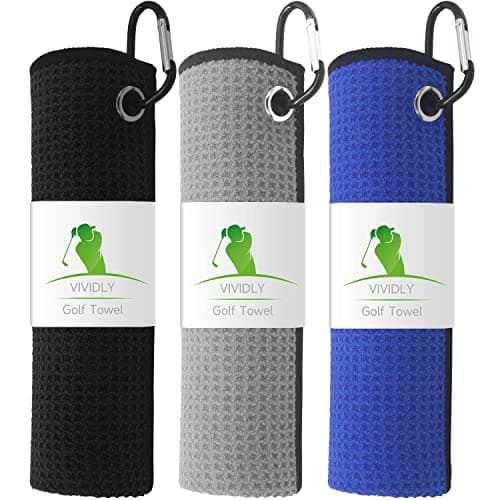
Buy several cheap towels. The unglamorous answer, and arguably the best one. A three-pack of 16-inch waffle towels costs less than a sleeve of premium balls. Keep one permanently wet on a carabiner, one permanently dry, and a third in the trunk for the day one of them is in the wash. You get a genuine two-zone system for less than any single branded towel on this page costs.
Clip, slit, grommet or magnet?
How the towel attaches matters more than it sounds, because the only real failure mode in this category is a towel that ends up on the ground.
A center slit— an 8-inch cut in the middle of the towel that drops over the clubs in the bag — is the carrier's answer. Nothing to break, nothing to rattle, and it is tucked away from rain. The cost is speed: you reach past the irons to get it, and it can catch a grip on the way out.
A carabinerhangs the towel outside where you can grab it one-handed. It is the right answer for a cart or push cart, and the clip is the part that fails — buy one with an aluminum hook, not a stamped steel ring.
A magnet is genuinely useful on a motorized cart, where the frame is steel and you want the towel at hand height rather than down by the bag. Read this one carefully, though: a magnet needs ferrous metal. Aluminum push-cart tubing, carbon frames and plastic cart shells give it nothing to hold on to, which is why every magnetic towel worth buying also ships with a clip. If you walk with a push cart, check our best push carts picks for what your frame is actually made of before you pay extra for a magnet.
How many towels do you need?
Two, minimum, and three is better. The two-towel system is the one piece of advice in this whole category that costs almost nothing and changes something real: one towel lives wet, one lives dry, and the wet one never touches the face right before a shot. A third towel in the car means the system survives laundry day.
Wash them more than you think, and wash them alone. Microfiber works by having an enormous amount of fiber surface area, and that surface area fills up with lint, dirt and fabric softener residue. Cold water, mild detergent, no softener — Club Glove specifies exactly that on its own towel, and it applies to every towel here. A gray, matted microfiber towel is not a dirty towel, it is a dead one.
If you are building out the bag properly, the towel sits alongside the other cheap items that earn their space: our what to keep in your golf bag list is the full inventory, and our best golf ball retrievers page covers the other tool that comes back out of the bag muddy.
The short version
Buy the 17 x 40 waffle microfiber caddy towel with the slit. Add a cheap three-pack so you can run one wet and one dry without thinking about it. Buy the magnetic pocket towel instead if you ride a steel-framed cart and want the wet zone built in. Buy the Frogger if you want the two-layer design done properly and will accept slower drying for it. Buy the Club Glove if you want the tour towel and know you are paying for the finish, not the spec. And if you buy the Titleist terry, keep it for dry days — because the one thing the published research is clear about is that a wet clubface costs you spin.
The two-towel system, in detail
Here is the whole method. At the first tee, soak one towel — properly wet, not damp — and clip or hang it on the side of the bag you reach with your off hand. Keep the dry towel on the other side, or over the clubs. Before every iron and wedge shot where the face has anything on it, scrub with the wet towel, then finish with one pass of the dry one. That second pass is the whole point, and it takes two seconds.
Why it matters: Plugged In Golf's testing found a new wedge lost about 30% of its full-swing spin from a single spray of water, and wet-face spin on worn wedges ran 5–20% below dry. Those are big numbers for a problem you can fix with a dry rag. The wet towel does the cleaning that a dry towel cannot; the dry towel does the drying that a wet one cannot. One towel doing both is doing half the job properly and half of it backwards.
Size, decoded
- 16 x 16 in. One zone. Great in multiples, hopeless alone. This is a clip-on scrubber, not a towel.
- Around 16 x 24 in. The common magnetic/pocket size. Big enough for a dry face plus a small wet pocket, small enough to hang on a cart without flapping.
- 17 x 40 in. The caddie standard. Folds to give you two real zones, drapes over clubs through a center slit, and covers the top of the bag in rain.
- 20 x 40 in. The most cloth available. Worth it in terry only if you like the fabric, because the extra size makes a slow-drying towel slower.
The claims, decoded
- “Three times more absorbent, dries five times faster.”The magnetic towel's listing says exactly this. There is no test behind it that we could find, no stated comparison product, and no methodology. Microfiber genuinely does out-absorb and out-dry cotton; the multipliers are decoration. We ranked the towel on its published dimensions and its pocket, not on its arithmetic.
- “Removes dirt better than cotton.” Repeated by nearly every microfiber listing here, and mechanically plausible: split synthetic fibers have far more edge per square inch than looped cotton. Treat it as a reasonable description of the fabric, not as a measured result.
- “Non-abrasive.” Worth taking seriously, and both Club Glove and the magnetic pick state it. You are wiping a painted driver crown and sometimes a soft forged face; a towel with grit embedded in it will mark both.
- “Tour caddy design.” Means 17 x 40 with a slit. That is all it means, and the cheap towels that say it are telling the truth.
Where the brand premium is real and where it is not
Compare the two 17 x 40 towels on this page line by line and the published specification is identical: waffle texture, non-abrasive, center slit, same dimensions, cold wash. One costs substantially more. What the premium buys is denser cloth, better hems and a towel that survives more wash cycles — real things, but things you discover over a season rather than read on a box. If the spec sheet is what you are shopping, the budget towel is the same purchase.
The Titleist premium is a different animal: you are paying for a woven script logo, and the genuine engineering content of the product is the bleed-free dye. If you want the Titleist towel because you want the Titleist towel, that is a perfectly good reason to buy something. It is not a performance reason, and this page is not going to pretend it is — the same way our are expensive golf balls worth it page refuses to pretend about the ball.
Rain changes the answer
Everything above assumes you are managing a bit of dew and some mud. In actual rain the problem inverts: nothing stays dry, and the towel's job becomes keeping grips usable rather than faces clean. That is when the two-towel system earns its keep hardest — one towel lives under an umbrella or inside the bag hood and comes out only to dry a grip. If you play in wet weather regularly, the towel is half the answer and your hands are the other half; our best golf rain gloves page covers the gloves built to grip better when they are soaked, and best golf rain gear covers staying dry enough that the towel has a chance.