Skip to content
Club&Carry

Hub 05 · Tech & Gadgets

SkyTrak Alternatives

SkyTrak set the benchmark for an affordable home simulator. Here is what to buy instead, depending on which part of it you actually wanted.

By Stephen V.Updated How we pick
#ad

We earn a commission when you buy through our Amazon links, at no extra cost to you. It never affects our rankings, and we say so when the cheaper product is the better buy. How this works.

The Garmin Approach R10 is the closest alternative to a SkyTrak for most people: it publishes a dozen-plus parameters including spin, runs indoors or at the range, and plays simulated rounds through Garmin Golf and E6 Connect. If what you wanted was accurate numbers with nothing to set up, the PRGR HS 130-A needs no phone at all. Our budget pick is the Rapsodo MLM — the cheapest honest way to learn your real carry distances. Note before you read on: at our last price check the SkyTrak itself had no buyable offer on the listing we track, which is part of why this page exists.

SkyTrak occupies a specific place in golf. It was the first unit to put photometric camera-based measurement — ball speed, launch angle, spin and shot shape read directly off the ball rather than inferred — at a price a serious amateur could justify, with 3D ball-flight visuals and simulator software behind it. People searching for an alternative are usually after one of its parts, not all of them, and the parts have very different prices.

What SkyTrak is actually known for

  • Photometric measurement. Cameras photograph the ball at impact, so spin and launch are measured rather than derived from radar. That is why it works in a net at short range, where Doppler radar units want space behind the ball.
  • Simulator-grade output. It was built to drive golf-course software, not just to tell you a carry number.
  • A complete build around it. Mat, net, screen, projector, software subscription. The unit is the cheapest part of that sentence.

If you want all three of those, nothing on this page is a complete substitute and we are not going to pretend otherwise. If you want one of them, keep reading — and read our are cheap golf simulators worth it page first, because the software and the room are where home-simulator budgets actually go.

Route one: spin numbers and simulated rounds, for less

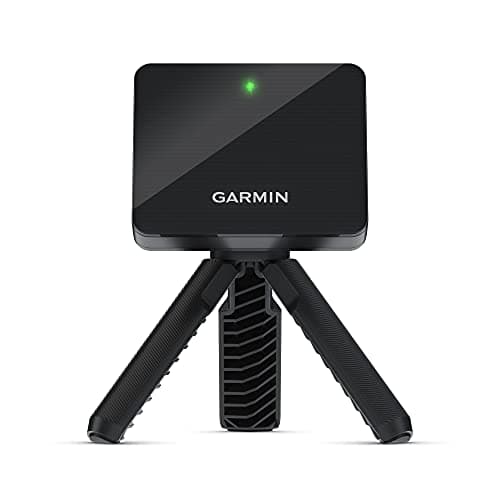
The Garmin R10 is the alternative most SkyTrak shoppers end up at. Garmin's published specification sheet lists a dozen-plus metrics including spin, a rechargeable battery good for around ten hours, IPX7 weather sealing, and indoor or outdoor use. It drives Home Tee Hero and E6 Connect for virtual rounds, and the specification sheet states plainly that those virtual rounds require a subscription — which is the number people forget when they compare hardware prices.

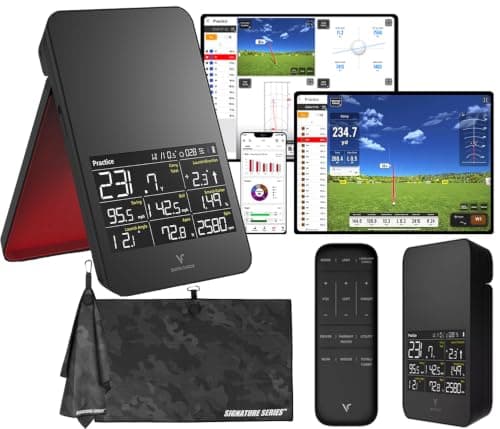
The Voice Caddie SC4 PRO is the other spin-capable route: eight parameters including spin, a 5.3-inch display with voice output, E6 Connect support and no laptop required. It costs more than the R10 and it is the pick if you want a self-contained unit with a screen rather than something that lives on a phone. Our R10 vs Rapsodo MLM page covers the subscription maths in detail.

Route two: real numbers, nothing to set up

A large share of people who buy a launch monitor never build a simulator. They want to know how far they actually hit a 7-iron. For that, radar units with their own screens are a better purchase than a camera unit with software behind it.

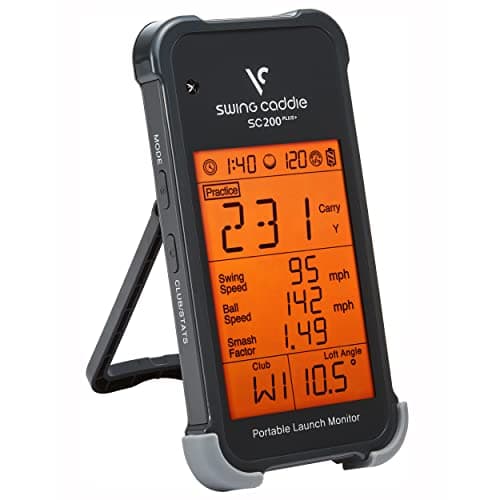
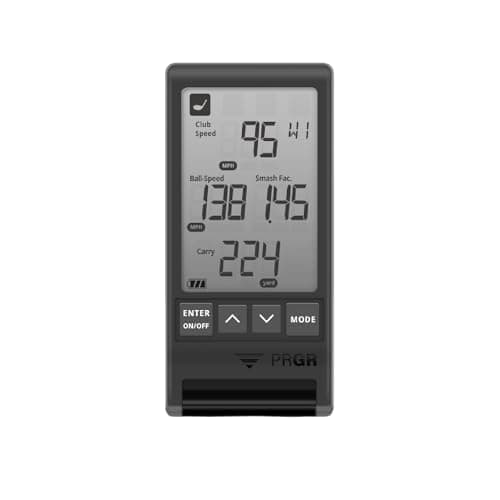
The PRGR HS 130-A is the pick: Doppler radar, no phone needed, club head speed, ball speed, smash factor, carry and total distance, 500 swings of memory and four AAA batteries. The Voice Caddie SC200Plus is the same idea with a 4-inch LCD and voice output, published tolerances of about three percent on ball speed and five percent on carry, and a 30 to 320 yard range. Both switch on and work.

Route three: the cheapest route to carry distances

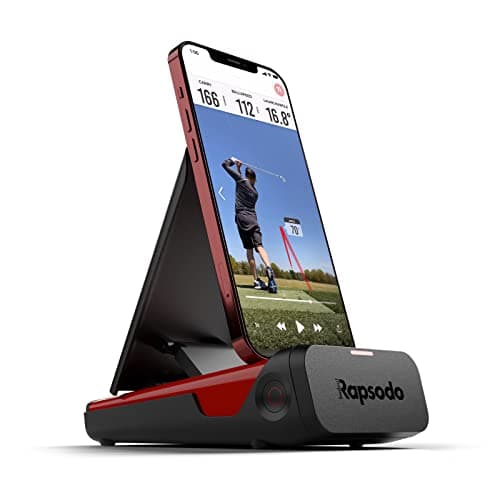
The Rapsodo MLM is our budget pick and the cheapest unit here. Rapsodo publishes which of its metrics are measured and which are derived, which is more honesty than this category usually offers, and the video replay with a shot tracer is genuinely useful. Two real constraints: it is iOS only, so an Android phone rules it out, and the Premium membership is where the full feature set lives. If your question is “what is my actual carry with each club,” it answers it for the least money.

Published specs, side by side

UnitTechnologySpinNeeds a phone?
SkyTrak (the original)Photometric camerasYes, measuredApp or PC, plus software
Garmin Approach R10RadarYes (subscription for virtual rounds)Yes
PRGR HS 130-ADoppler radarNoNo
Voice Caddie SC4 PRORadarYes, 8 parametersNo (5.3in display)
Voice Caddie SC200PlusK-band Doppler radarNoNo (4in LCD)
Rapsodo MLMCamera + radar, iOS appDerived, with RCT ball supportYes, iOS only

Live prices for the five picks, with a per-row buy link and the date each price was checked, are in the Quick Picks table above. We do not quote prices in prose, and we do not quote a price for the SkyTrak at all, because our last check returned no buyable offer for it.

How to choose between them in one paragraph

Want to play courses on a screen in your garage? The R10, and budget for the subscription and the room. Want spin data without a laptop? The SC4 PRO. Want to stand on a range and find out what your clubs actually do? The PRGR, or the SC200Plus if you prefer voice output. Want the answer for the least money and own an iPhone? The Rapsodo. Our best golf launch monitors page ranks the same field without the SkyTrak framing, and our best budget home golf simulators page covers what else a full build needs.
The short answer

Quick picks

#ProductBest forScorePrice
01
Garmin Garmin Approach R10 Launch Monitor
Garmin Approach R10 Launch Monitor

The step up that changes what you can see: a dozen-plus metrics including spin, plus virtual rounds at home. The one most golfers should stretch for if the room allows it.

Spin numbers and simulated rounds
7.6
$499.99Amazon
02
PRGR PRGR HS 130-A Portable Launch Monitor
PRGR HS 130-A Portable Launch Monitor

The cheapest device that will tell you your real ball speed and carry, with no phone, no app and no setup. The value answer in the whole category.

Real numbers with nothing to set up
8.2
$194.99Amazon
03
Voice Caddie Voice Caddie SC4 PRO Launch Monitor
Voice Caddie SC4 PRO Launch Monitor

Eight measured parameters including spin, on a 5.3-inch screen that works without a phone and plays simulator courses when you want one. The ceiling of the sensible band.

Spin data without a laptop setup
7.8
$504.99Amazon
04
Voice Caddie Voice Caddie SC200Plus Launch Monitor
Voice Caddie SC200Plus Launch Monitor

A standalone radar with a four-inch screen that reads your distance out loud — the practice-range unit for anyone who does not want to look at a phone.

Range sessions without a phone
7.8
$179.99Amazon
05
Rapsodo Rapsodo Mobile Launch Monitor (MLM)
Rapsodo Mobile Launch Monitor (MLM)

Real ball and club numbers for a fraction of what a launch monitor used to cost. The single highest-value piece of home practice tech here.

Learning your actual carry distances
8.4
$129.98Amazon

#ad · Live prices from the Amazon Product API, as of November 12, 2026. Where we have no verified live price, we show none — we would rather leave a gap than print a number that has rotted.

In detail

The picks, in full

01
Garmin Garmin Approach R10 Launch Monitor

Spin numbers and simulated rounds

Garmin Approach R10 Launch Monitor

A dozen-plus metrics incl. spinRechargeable, up to 10 hrGarmin Golf + E6 ConnectIPX7, indoor or range
7.6/10

The step up that changes what you can see: a dozen-plus metrics including spin, plus virtual rounds at home. The one most golfers should stretch for if the room allows it.

Data quality
9
Setup ease
7
Space needed
5
Fun factor
9
Value
8

Pros

  • Garmin publishes more than a dozen live metrics — club head speed, ball speed, swing tempo, ball spin and launch angle among them — which is the first point on this page where the data diagnoses rather than just scores
  • Home Tee Hero in the Garmin Golf app turns the same hardware into virtual rounds on tens of thousands of real courses, so the unit keeps earning its keep in winter
  • Rechargeable battery rated up to ten hours and an IPX7 water rating, so a wet range session is not a problem

Cons

  • Indoors it needs real room — Garmin's guidance puts the unit six to eight feet behind the ball with about eight feet of flight in front of it
  • The free E6 Connect course set is iOS-only and small; the full course library is a paid subscription on top of the hardware

Don't buy this if…

…your practice is a net in a single-car garage. Radar needs ball flight to work from, and a unit that costs twice the PRGR is wasted if the ball hits canvas after six feet.

$499.99View on Amazon

Price as of November 12, 2026. Prices change — Amazon's is the one that counts.

#ad · we may earn a commission from this link to Garmin Approach R10 Launch Monitor

02
PRGR PRGR HS 130-A Portable Launch Monitor

Real numbers with nothing to set up

PRGR HS 130-A Portable Launch Monitor

Doppler radar, no phone neededClub + ball speed, smash, carry/totalStores up to 500 swings4x AAA, IP54
8.2/10

The cheapest device that will tell you your real ball speed and carry, with no phone, no app and no setup. The value answer in the whole category.

Data quality
7
Setup ease
10
Space needed
8
Fun factor
6
Value
10

Pros

  • Works entirely on its own — no phone, no pairing, no app account, which is why it gets used on a weeknight
  • Measures the five numbers that actually change club selection: club head speed, ball speed, smash factor, carry and total distance
  • Pocket-sized at about five ounces on AAA batteries, so it lives in the bag and comes to the range

Cons

  • No spin, no launch angle and no club path — the diagnostic numbers stop at smash factor
  • The on-device history is 500 swings with no phone app behind it, so long-term tracking means writing it down

Don't buy this if…

…you want to see the shot as well as the numbers. There is no video, no tracer and no simulator here — the Rapsodo MLM is the same money if you have an iPhone.

$194.99View on Amazon

$229.9915% off

Price as of November 12, 2026. Prices change — Amazon's is the one that counts.

#ad · we may earn a commission from this link to PRGR HS 130-A Portable Launch Monitor

03
Voice Caddie Voice Caddie SC4 PRO Launch Monitor

Spin data without a laptop setup

Voice Caddie SC4 PRO Launch Monitor

8 parameters incl. spin5.3in display + voice outputE6 Connect simulator playRechargeable, ~10 hr
7.8/10

Eight measured parameters including spin, on a 5.3-inch screen that works without a phone and plays simulator courses when you want one. The ceiling of the sensible band.

Data quality
9
Setup ease
8
Space needed
6
Fun factor
9
Value
7

Pros

  • Eight parameters — carry and total, ball and swing speed, smash factor, apex, launch angle and direction, and spin — read straight off the device with no phone required
  • Big 5.3-inch display with voice output, so it is as usable standing over a ball at the range as it is indoors
  • Pairs to E6 Connect for simulator play and to Voice Caddie's own app for a 3D driving range, which the cheaper units on this page cannot do

Cons

  • Three times the price of the PRGR for data most mid-handicappers will not act on
  • Amazon stock for it is seller-assembled 'Signature Series' bundles rather than a plain boxed unit, so check what is in the box before you buy

Don't buy this if…

…you are buying your first launch monitor. Start at the bottom of this page, find out whether you use it weekly, and spend this much only once the answer is yes.

$504.99View on Amazon

$599.9916% off

Price as of November 12, 2026. Prices change — Amazon's is the one that counts.

#ad · we may earn a commission from this link to Voice Caddie SC4 PRO Launch Monitor

04
Voice Caddie Voice Caddie SC200Plus Launch Monitor

Range sessions without a phone

Voice Caddie SC200Plus Launch Monitor

Carry, swing speed, ball speed, smash4in LCD + voice outputPractice-swing speed modeDoppler radar, 30-320 yd
7.8/10

A standalone radar with a four-inch screen that reads your distance out loud — the practice-range unit for anyone who does not want to look at a phone.

Data quality
7
Setup ease
9
Space needed
8
Fun factor
6
Value
9

Pros

  • Voice output calls the number after every shot, so you never break position to read a screen
  • Practice-swing mode reads club head speed with no ball at all, which is the one thing a speed-training session needs
  • Voice Caddie publishes a barometric-pressure calibration and per-club daily and all-time stats — unusual at this price

Cons

  • Four data parameters only: carry, swing speed, ball speed and smash factor. No spin, no launch angle
  • Voice Caddie's own published accuracy is a tolerance, not a guarantee — about 3% on ball speed and 5% on carry

Don't buy this if…

…you want to play simulated courses at home. This unit measures and speaks; it does not connect to simulator software. The Garmin R10 is where that starts.

$179.99View on Amazon

$229.9922% off

Price as of November 12, 2026. Prices change — Amazon's is the one that counts.

#ad · we may earn a commission from this link to Voice Caddie SC200Plus Launch Monitor

05
Rapsodo Rapsodo Mobile Launch Monitor (MLM)

Learning your actual carry distances

Rapsodo Mobile Launch Monitor (MLM)

Ball + club speed, launch angle, carryVideo replay with shot traceriOS only (iPhone/iPad)Range or net use
8.4/10

Real ball and club numbers for a fraction of what a launch monitor used to cost. The single highest-value piece of home practice tech here.

Data quality
8
Setup ease
8
Space needed
8
Fun factor
8
Value
10

Pros

  • Gives carry distance, ball speed, club speed, launch angle and shot shape — the numbers that actually change club selection
  • Video replay with an on-screen tracer makes a fault visible instead of theoretical
  • Works at the range, in the garden or into a net, so it is not tied to one setup

Cons

  • iOS only — it pairs with an iPhone or iPad and nothing else
  • Simulator courses and game modes sit behind a premium subscription

Don't buy this if…

…you are an Android household. That is a hard blocker, not a preference — check before you buy.

$129.98View on Amazon

Price as of November 12, 2026. Prices change — Amazon's is the one that counts.

#ad · we may earn a commission from this link to Rapsodo Mobile Launch Monitor (MLM)

How we picked

We do not run a testing lab

We compiled the published specifications, did the cost-per-round and value math, and read the independent robot and launch-monitor data — then scored each product against a published rubric. The scores are judgments from documented research — they are not measurements we took, because we do not have a lab and we are not going to pretend we do. Where a number came from someone else's lab, we name them and link them in Sources.

Questions

Frequently asked

What is the best SkyTrak alternative?
The Garmin Approach R10 for most people. It publishes a dozen-plus parameters including spin, works indoors or at the range, and plays simulated rounds through Garmin Golf and E6 Connect. Garmin's own specification sheet notes that the virtual-round features require a subscription, which belongs in any price comparison.
Is there a cheaper launch monitor than SkyTrak?
Several, and they are not close in price. The Rapsodo MLM is the cheapest here and answers the commonest question — what do I actually carry with each club — while the PRGR HS 130-A does it with no phone at all. What you give up at those prices is measured spin and simulator-grade output.
Do I need a photometric launch monitor for a home simulator?
It helps in a small room. Camera-based units read the ball at impact, so they work in a net at short range, while Doppler radar generally wants space behind the ball to track flight. If your space is tight, that is the single strongest argument for a camera unit over a radar one.
Does the Garmin R10 need a subscription?
For the virtual-round features, yes — Garmin's published specification sheet states that Home Tee Hero and virtual rounds require a subscription. The basic shot data does not. Factor the recurring cost in when you compare it against a one-off hardware price.
What launch monitor measures spin for the least money?
Among our picks, the Garmin R10 is the cheapest unit that publishes spin among its parameters; the Voice Caddie SC4 PRO lists eight parameters including spin in a self-contained unit with a screen. The radar units with their own displays, like the PRGR and the SC200Plus, do not report spin at all — they report speed, smash and distance.
Is a launch monitor worth it if I am not building a simulator?
Often more worth it. Knowing your real carry distances changes club selection on every approach shot you hit, and that is a scoring gain available without a screen, a projector or a subscription. A unit with its own display and no phone requirement is the cheapest honest route to it.

Keep reading

Receipts

Sources

We do not run a testing lab, and we do not pretend to. Where a measured number came from someone else's lab or robot, we name them and link them. Where we could not verify something, we say so on the page rather than quietly leaving it out. Read our full method.