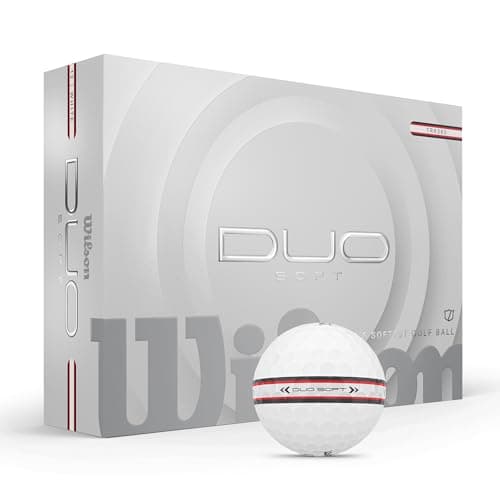
The Wilson Duo Soft is one of the lowest-compression balls you can buy: a genuinely buttery feel for the slowest swings, at a value price — provided your swing is slow enough to leave it soft rather than mush it flat.
Most golf balls chase a balance between feel, distance and spin. The Duo Soft chases one property to an extreme: softness. Wilson built it around an extremely low-compression core — one of the lowest on the market — and the result is a ball that feels like almost nothing off the face. It is plush off the putter, gentle into the irons, and effortless to get airborne. For the player it is designed for, that softness is the entire appeal and the whole reason to buy it. But softness this aggressive is a specialist tool, not a universal upgrade, and the honest version of this review is as much about who should stay away as who should rush to buy. Get the match right and it is one of the best value soft balls in golf; get it wrong and you will wonder what everyone sees in it.
Who the Duo Soft is for
This ball is built for a slow swing speed — roughly under 85 mph off the driver — and the rule of thumb is simple: the slower you swing, the more sense it makes. At gentle speeds you cannot fully compress a firm ball, so a firm ball feels hard, launches low and quietly leaves distance on the table. The Duo Soft's ultra-low compression squashes easily even at those speeds, which is exactly why it launches so readily and feels so soft. It flies straight with an easy, forgiving launch that flatters a slower or less consistent swing, and because Wilson prices it at the value end and sells it widely, you are not paying a premium for the softness — you are paying less than you would for a firm premium ball you could not use anyway. If you have watched your swing speed drift down over the years and your old ball start to feel like a rock off the face, this is one of the simplest, cheapest fixes on the shelf. It is a natural pick on our best golf balls for slow swing speeds list.
The standout: feel
Feel is the whole reason to buy this ball, and it delivers a feel that few balls at any price can match. Off the putter it is quiet and plush, with a soft, dead-weight roll that a lot of golfers find gives them better distance control on the greens. Into a wedge or a short iron it gives that pillowy, cushioned sensation people chase and rarely find this cheaply. And because the compression is so low, a slow or moderate swing gets that softness through the entire bag — driver, irons and putter — not just on and around the green. Wilson has kept this softness as the ball's signature across generations, so you are getting a formula honed specifically around feel rather than a compromise struck to chase distance. If the single thing you care about most in a golf ball is how it feels off the face, and your swing is not fast enough to firm it up, the Duo Soft is close to the softest money can buy. That is a real, specific strength backed by its construction, not a marketing line, and it is why it takes the softest-feel nod here.
Who should look elsewhere
The very extreme that makes the Duo Soft great for a slow swing makes it wrong for a fast one. If your driver swing is above about 95 mph, you will over-compress it: the feel tips over from soft into dead and mushy, and you leave both distance and control behind. A faster swinger is far better served by a firmer ball — a value distance ball like the TaylorMade Distance+ off the tee, or a value urethane ball if you can genuinely use spin. The second limit applies to everyone, whatever your speed: the Duo Soft is low-spin all round, so it gives you no help stopping the ball on a firm green. It will not check or bite from a full wedge the way a urethane ball does, and it will release and run out on firm approaches. If you score with your short game and want the ball to stop, this is not your ball. It is worth saying plainly, because it trips people up: softness of feel and spin around the green are not the same thing, and the Duo Soft has the first in abundance and the second barely at all.
The value verdict
Judged for what it actually is, the Duo Soft is an easy recommendation: about the softest feel in golf, at a value price, for the slower swing it was built to serve. It is not trying to be an all-rounder, and buying it expecting distance for a fast swing or spin around the greens would be judging it against a job it never applied for. Match it to a slow, feel-first game and it is superb value — the kind of clean, specific value this whole site is about. It is not the ball for every golfer, but for the one it fits it is hard to beat on feel-per-dollar, and that narrow focus is precisely the point. If you are close but want a fraction more distance while keeping most of the soft feel, the Srixon Soft Feel is the half-step-firmer alternative, and you can see how all the softest picks stack up on our best soft golf balls ranking.