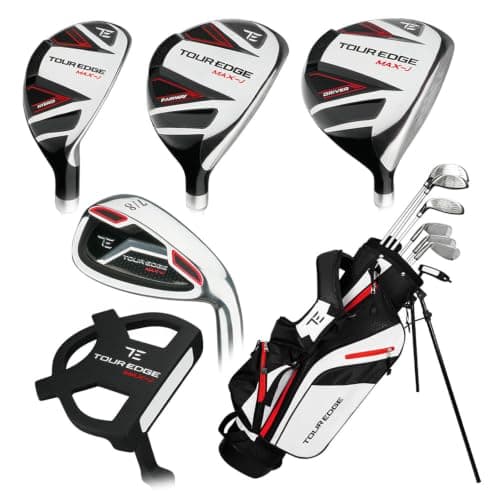
The Tour Edge Max-J is the best junior golf set for most families. It comes in five sizes that step up about six inches at a time, every loft and length is published, and it undercuts the Callaway and TaylorMade junior sets we checked. If the budget is tight and your child is at the taller end of the 9-12 range, the Precise XDJ is the cheapest set we found with a full published spec table. For a five-to-eight-year-old who is just starting, skip the set: buy one Orlimar ATS junior iron and a putter.
A note on the prices below. Complete-set and club prices on Amazon swing widely with third-party sellers — the live number on each card is today's, stamped with the date we checked it. If a set looks overpriced, it usually is, and it tends to come back down; it's also often cheaper in-store or direct. Treat the live price as a starting point and shop it around before you buy.
Why the age on the box is the least useful number on it
Every junior set is sold by age, and almost none of the people who make them agree on what an age means. The real fitting number is height, and the height ranges printed by the manufacturers show how far apart two sets with the same age label can be. Here is what each maker publishes for the sets on this page and one step up.
| Set | Age label | Published height | Band width |
|---|
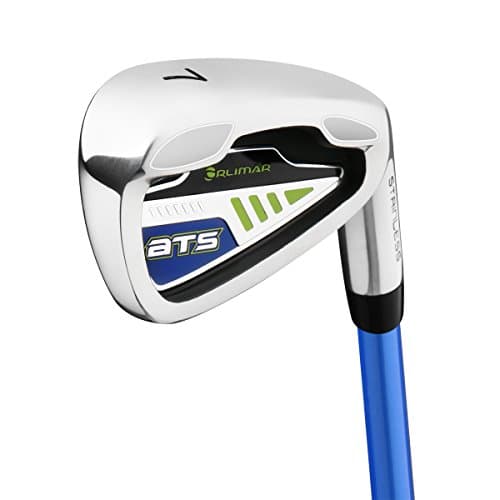
| Orlimar ATS (Blue/Lime) | 5-8 | 44-52 in | 8 in |
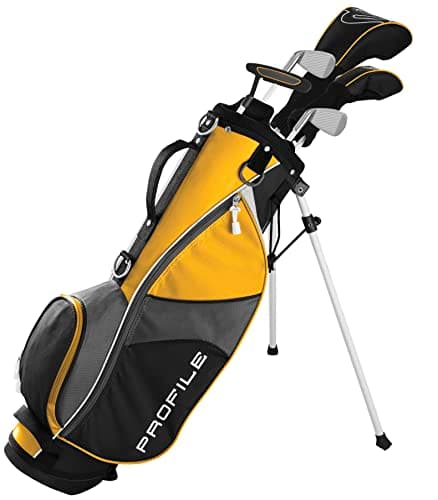
| Wilson Profile JGI Medium | 8-11 | 50-56 in | 6 in |
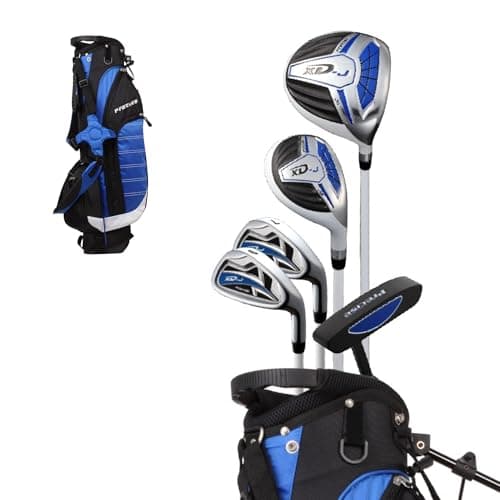
| Precise XDJ | 9-12 | 52-61 in (4'4"-5'1") | 9 in |
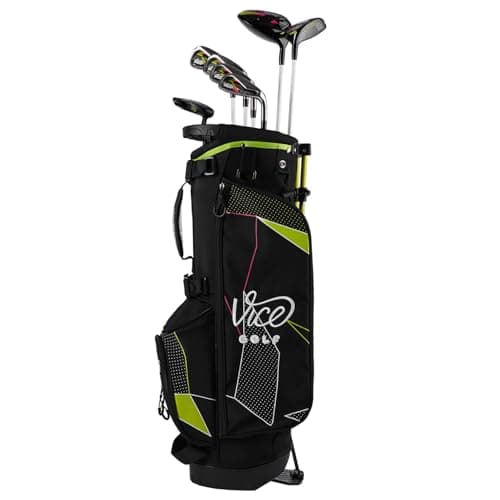
| Vice Golf Junior 8-piece | 9-12 | 54-58 in | 4 in |
| Wilson Profile JGI Large | 11-14 | 56-63 in | 7 in |
| Tour Edge Max-J (Red) | 9-12 | 58-64 in | 6 in |
| U.S. Kids Golf (any size) | by height | 3-inch steps, 36-69 in | 3 in |
Read the three rows marked 9-12. Precise's 9-12 set starts at 52 inches. Vice's starts at 54. Tour Edge's starts at 58. A ten-year-old who stands 4'7" fits the Precise and the Vice and is three inches too short for the Tour Edge. The label is the same and the answer is different. Height is the only number that settles it.
The band width column matters as much as the start point. A narrow band means a closer fit and a shorter life. U.S. Kids Golf, whose height-based system is the reference point for this category, fits in three-inch steps. Precise covers nine inches with one set, so the clubs have to be too long for the smallest children in that range, too short for the tallest, or both. Neither approach is wrong. They are different trades between fit and cost, and the rest of this page is about making that trade on purpose.
How we picked
Six criteria, applied in this order. We do not run a testing lab and we have not had children swing these clubs. Every judgment below comes from the manufacturers' published and retailers' published specifications, named fitting sources, and the live retail listing.
- A published height range. Not just an age. Every pick here states the height it was built for, so you can measure your child and check.
- Published lofts and lengths, where the maker gives them. Four of the five picks publish club-by-club numbers. That is how we could see that two sets with the same age label differ by more than three inches at the driver. Where a maker publishes nothing, the cons say so.
- A true junior build. That means light heads, a junior shaft flex and a grip sized for small hands. No shortened adult clubs, for the reasons set out below.
- The right number of clubs for the size. More clubs is not better for a child. We favored sets whose club count grows with the size, and we ranked a single club for the youngest players.
- Both hands, where it exists. Left-handed children are easy to forget in junior ranges. Four of the five picks come in left hand, and the cons flag the one that does not.
- Availability today. Every set was verified live, in a right-handed build and the size named on its card, before it went on the page. The price on each card comes from the retailer, not from us.
How to size junior clubs in two minutes
U.S. Kids Golf's instruction is the simplest one there is: measure your player's height in inches with shoes on, then pick the set by that height. Do that before you look at a single listing. Then compare the number with the published height range, not the age.
Next, look at where your child sits inside the band, because the club lengths tell you which end of the band a set was built for. Precise builds its 9-12 driver at 39 inches. Tour Edge builds the driver in its 58-64 inch set at 39.5 inches, and the driver in its 52-58 inch set at 35.5 inches. So a 54-inch child in the Precise set swings a driver about three and a half inches longer than Tour Edge would give them. Vice, whose 8-piece set covers 54-58 inches, makes its driver 36 inches. When the maker publishes lengths, that comparison takes a minute and tells you more than any product photo.
The awkward case is a child between sizes. Haggin Oaks, a golf retailer that fits U.S. Kids Golf clubs, advises going to the next size up for room to grow. That is reasonable advice as far as it goes: one size, not two. The opposite instinct, buying a set well above your child's height so it lasts, is the one to resist. Dan Van Horn, the founder of U.S. Kids Golf, says it plainly in his letter to parents: “Don't use a longer driver to gain a few yards now. It's not worth it.” A club that is too long is heavier in the swing and harder to control, and a child who can't control it stops enjoying the game.
How many clubs a junior actually needs
Fewer than you think, and fewer the younger they are. Van Horn's advice for a child's very first clubs is one club and a putter. The manufacturers build their ranges the same way. Tour Edge's smallest Max-J set has three clubs. Its 5-8 and 7-10 sets have five. Only the 9-12 and 11-14 sets reach seven. Precise's 9-12 set has five clubs, and Wilson's Medium has five.
That progression tracks what a child actually does on a course. A young beginner hits one club off the ground and putts. A child playing short holes needs something to hit off a tee, something for the middle of the hole and something for around the green. Only a junior playing full-length holes regularly gets real use out of a fairway wood, a hybrid and a sand wedge. A bag stuffed with clubs a child can't tell apart is weight to carry, not help. The same logic applies to adults, which is why our guide to the clubs a beginner needs stops at seven.
Never cut down an adult club
The oldest money-saving move in junior golf is also the worst: taking an adult club and sawing a few inches off the shaft. It looks like the right length. It is the wrong club in every other way. The head is still an adult head, far too heavy for a child's speed, and shortening a shaft makes it stiffer. GOLF.com's equipment writer Ryan Barath put it this way: cut much more than three or four inches off and “you're effectively turning it into an ultra-stiff steel pole with a golf club head attached to it.”
Van Horn started U.S. Kids Golf because of exactly this problem. In his own account, the cut-downs and junior clubs his children used “were too heavy; they were not only hurting my kids' swings but also their desire to play.” The second half of that sentence is the one that matters to a parent. A child who can't get the ball airborne doesn't end up with a worse swing so much as a new hobby. Every pick on this page is a true junior build.
What to spend when they will outgrow it
Here is the fact that should set your budget. Children between six and twelve grow about 2.5 inches a year, according to Nemours KidsHealth, and Van Horn tells parents to expect 2.5 to 3 inches a year before puberty. Divide a set's band width by that and you get roughly how long it fits a child who starts at the bottom of the band. Vice's four-inch band lasts about a year and a half. Tour Edge's and Wilson's six-inch bands last a little over two years. Precise's nine inches stretch past three years, with a looser fit along the way.
Now look at the other end, which is what an outgrown set is worth. Very little. U.S. Kids Golf runs a TradeUP program, but it only accepts U.S. Kids Golf clubs, and the credit is $5 to $7 a club, issued as a code for its own store. PGA TOUR Superstore's trade-in program excludes package and complete sets altogether. So a junior set is a consumable, and the value rule follows from that: pay for the height fit, because it decides whether your child enjoys the next two years, and don't pay extra for a badge that won't hold its value.
There are two honest ways to stretch the money. One is a younger sibling, which is where a set with a long warranty is worth more. Tour Edge guarantees its clubs for a lifetime of use, though the bag and headcovers are excluded. The other is the used market, where outgrown junior sets turn up constantly. Our guide to buying used golf clubs covers what to check. For a junior set, the height range and the grips are nearly the whole inspection.
What we left out, and why
Callaway's XJ and TaylorMade's junior sets are serious, well-made ranges, and both cost well into the premium bracket. We left them out for a practical reason. On the day we checked, the TaylorMade listings we could verify showed no buy-box price, and the Callaway XJ listings did not name the size in their titles, so we couldn't tell a buyer which set they would receive. Cleveland's junior Medium set was not in stock. We also passed on two cheaper sets because their listings contradict themselves. One describes the contents of its 7-piece set two different ways on the same listing. The other publishes a 9-iron longer than its own driver. If a listing can't tell you what is in the box, it isn't a safe recommendation.
U.S. Kids Golf itself isn't ranked, because we couldn't find a current U.S. Kids set in the Amazon catalog our live prices come from. Its three-inch sizing is the benchmark everything above is measured against, and it is worth pricing on its own site before you buy.
When a junior is ready for adult clubs
Height eventually stops being the question and swing speed takes over. U.S. Kids Golf publishes a chart that moves a player from its lightweight sets to its heavier Tour Series by driver swing speed at each height. It recommends adult equipment once a player's driver swing speed reaches 90 mph or more. Until then, its guidance is to stay in junior equipment.
When that point comes, the value rules on the rest of this site apply. A forgiving complete set is the right first adult set, and our best golf sets for beginners ranking covers it. A teenager who is still short for a standard-length club should look at shorter builds too. The length-fitting logic on our women's golf club sets page applies to anyone who is still small for a full-length club. Our shaft flex guide explains how to read the swing-speed number once you have it.
What we would actually buy
A nine-to-twelve-year-old who is 58 inches or taller and plays regularly: the Tour Edge Max-J in the Red size. It has seven clubs, a mallet putter, published numbers and a lifetime warranty on the clubs, and it undercuts the big-brand sets. If they are 52 to 58 inches, buy the same set one size down.
The same child on a tight budget: the Precise XDJ 9-12, as long as they are in the upper half of its 4'4" to 5'1" range. A shorter child gets a better-fitting set for less money by sizing down.
A smaller eight-to-eleven-year-old between 50 and 56 inches: the Wilson Profile JGI Medium, and use the fingertip-to-ground measurement as a second check.
A five-to-eight-year-old who is just curious: one Orlimar ATS junior 7-iron and a putter. If they are still asking to go to the range in six months, buy the five-club set in the right height band.
A committed junior who has played full rounds and is 54 to 58 inches tall: the Vice Golf 8-piece, knowing that its four-inch band will need replacing sooner than anything else here.
Whichever set you buy, the balls matter more than you would think. A junior swing is slow, and a soft, low-compression ball is built for exactly that speed. Our best golf balls for slow swing speeds ranking covers them for a fraction of what a set costs. Spend where it matters.