Skip to content
Club&Carry

Hub 05 · Tech & Gadgets

The Best Golf Tees

Tee height changes your drive by about fourteen yards. The tee itself changes it by nothing anyone has been able to measure.

By Stephen V.Updated How we pick
#ad

We earn a commission when you buy through our Amazon links, at no extra cost to you. It never affects our rankings, and we say so when the cheaper product is the better buy. How this works.

Buy a big box of 3-1/4 inch wooden tees and stop thinking about it. That is the honest answer, and it is the answer the independent testing supports. If your tee height wanders from shot to shot, buy step-down castle tees instead — they are the only tee on this page that changes anything measurable about your drive. And if you hit off a mat at home, buy rubber mat tees, because a wooden tee in a mat snaps on the first fat strike.

Tees are the cheapest thing in your bag and the most over-claimed. Walk the accessories aisle and you will find tees sold on reduced friction, on brush bristles, on prongs that “cradle” the ball, and at least one sold on a specific number of extra yards printed on the box. We went looking for the evidence behind those claims, and then ranked the field on the three things that survive scrutiny: what each tee costs per shot, how many strikes it survives, and whether it helps you tee the ball at the same height twice.

How we ranked these

We do not run a lab and we have not put these tees on a launch monitor ourselves. What we did instead is read the published independent testing on tees, check what each listing actually states about length, material and pack count, and rank on cost per shot against durability. Our methodology page spells out the same rule for every category on this site: a number somebody measured beats a claim somebody printed.

  1. Cost per tee, not price.A small pack of performance tees and a hundred-count bulk bag are not the same kind of purchase. Per tee, the gap runs to more than tenfold — check the live prices below against the pack size.
  2. Strikes survived.Wood breaks, plastic bends, bamboo splits late, rubber never dies. Durability is what justifies a higher unit price — and it is a real benefit, unlike distance.
  3. Repeatable height. The one tee property with measured performance behind it. A step or a mark that stops at the turf beats pushing a smooth tee in by feel.
  4. Length for the club. 3-1/4 inches for a modern large-head driver, around 2-3/4 for a fairway wood or hybrid, and something short for an iron on a par 3.

The one thing about tees that is actually worth yards

MyGolfSpy's tee-height test compared a ball teed 1.5 inches above the ground against one teed at 0.5 inches, and the gap was not subtle: the higher tee produced about 14.19 yards more carry and 14.66 yards more total distance on average, with launch angle roughly 3.54 degrees higher. The low tee lost its distance mainly to low-face contact — strikes down toward the bottom grooves, which is exactly where a driver gives back ball speed.

That is the whole mechanism of this category. Teeing the ball high enough to strike it above the center of the face, slightly on the way up, is free distance. It costs nothing, it needs no special tee, and most amateurs tee the ball too low. If you want the full version of that argument, our guide to what loft driver you should use covers how launch and angle of attack work together, because tee height and loft are the same conversation.

The practical takeaway: pick a tee whose height you can repeat. A step-down castle tee does that by design, which is why it is on this page despite being an unbranded commodity. A 3-1/4 inch wooden tee does it well enough once you learn a reference mark on the tee and push it to the same point each time.

And the thing that is not: tees sold on distance

MyGolfSpy's 2020 tee test put three of the best-known alternative tees — FlightPath, Martini and 4 Yards More — against a standard wooden tee, at 120 drives per tee with a Ping G410 LST driver. The conclusion was that there is no reliable evidence that any of the alternative tees tested provides a significant benefit over wood, and for the one with a distance claim in its name, the data put it statistically identical to a wooden tee. The test also found evidence of a distance loss for at least one of the designs.

We have still ranked two claim-based tees here, and the reason is important: they are good products for a reason that has nothing to do with their marketing. A Zero Friction prong tee or a 4 Yards More tee survives dozens of drives where a wooden tee survives a handful. If you practice a lot, that durability is worth money. The yards are not, because nobody has measured them.

Wood, bamboo, plastic or rubber?

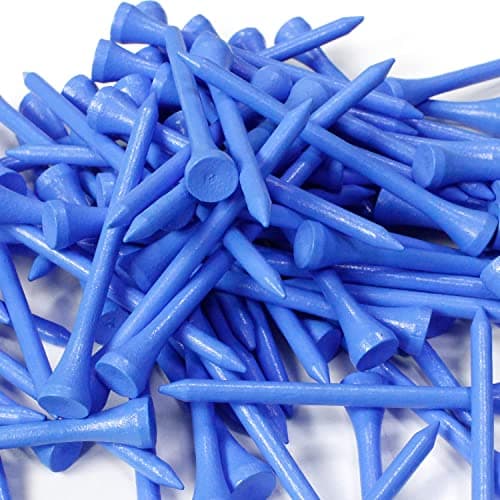
  • Wood. The default and the control group. Cheap by the box, biodegradable, snaps when you strike it fat. Buy 3-1/4 inch unless you tee down deliberately.
  • Bamboo. Technically a grass, not a wood, with long parallel fibers that resist splitting better than cheap hardwood. The cheapest cost per tee you can find, and a little stiffer in feel.
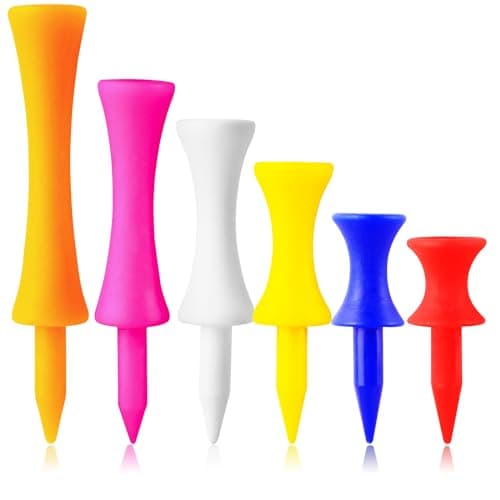
  • Plastic.Lasts far longer, holds a molded height, and is the only material that can give you a step. Costs several times more per tee, and bends rather than breaking — which means you can keep using a crooked one without noticing.
  • Rubber. Not a course tee. These are the plugs that sit in the hole of a hitting mat so you can tee a ball at home without destroying wood all afternoon.

What the Rules of Golf say about your tee

There is a limit, and it is worth knowing because the tall tees sold for drivers sit close to it. The USGA's equipment rules state that a tee must not be longer than 4 inches (101.6 mm)— that is total length, not the part above the ground — and that it must not be designed or made in a way that could indicate the line of play, unduly influence the movement of the ball, or otherwise help the player in making a stroke.

In practice every tee on this page is comfortably legal: the longest is 3-1/4 inches. Where golfers get caught out is with novelty tees that have an arrow, a pointer or an alignment feature molded into the top, and with the very tall 4-inch-plus tees sold for driving-range use. If you post scores or play club competitions, buy a plain tee and spend the thinking elsewhere.

How many tees do you actually need?

More than you think if you buy wood, and fewer than you think if you buy plastic. A golfer playing weekly will go through a wooden tee every few holes once you count the ones that break, the ones that fly into the rough, and the ones left in the tee box. That is the argument for the 135-count box: it is a season in one purchase, and the cost per round is pennies.

A plastic prong tee, by contrast, can survive weeks of range work. The right way to shop this category is to buy both: a box of wood for rounds, where tees get lost as often as broken, and two or three plastic tees for the range mat or practice bay, where they get struck constantly but never disappear. If you are putting a bag together from scratch, what to keep in your golf bag lists the rest of the kit that earns its weight.

Teeing off a mat at home

If your practice happens in a garage or on a mat in the yard, wooden tees are the wrong purchase entirely. Most hitting mats have a punched hole for a rubber tee; the rubber plug flexes out of the way at impact instead of snapping, and a set of mixed heights lets you practice driver, hybrid and iron tee shots from the right height rather than all three from whatever the mat came with. Our best practice nets and mats roundup covers the mats these fit, and best budget simulators covers the screen-and-sensor setups where a repeatable tee height matters even more, because the sensor is reading every strike.

The short version

Buy the 135-count box of 3-1/4 inch wooden tees. If you want the cheapest possible cost per shot, buy the bamboo bag instead. If your tee height is inconsistent — and it probably is — buy castle step-down tees and let the step do the measuring. Buy a few plastic prong tees for range work because they last, not because they add yards. Buy rubber tees if you hit off a mat. And do not spend more than a few dollars chasing distance in a product that the testing says does not provide any.

The same logic applies to the other small things that live in the same pocket: a divot tool and a ball marker are categories where the expensive version buys finish rather than function, and a multipack beats one good one for the same reason it does with tees — you will lose them.

The short answer

Quick picks

#ProductBest forScorePrice
01
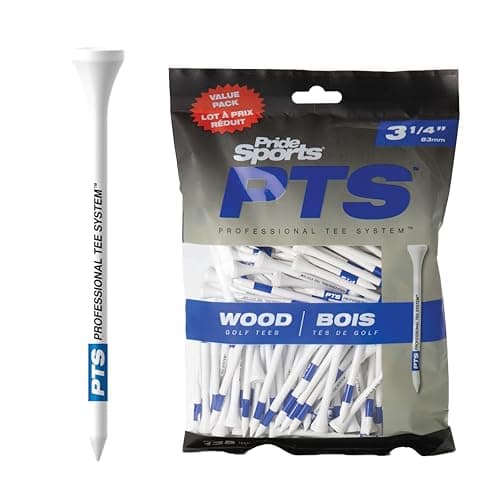
Pride PrideSports PTS Wood Golf Tees (135 count, 3-1/4 in)
PrideSports PTS Wood Golf Tees (135 count, 3-1/4 in)

The plain wooden tee, bought in a box big enough to last a season. Independent testing has never found an alternative tee that beats wood, which makes this the category's value answer.

Almost everyone, almost all the time
7.6
$14.99Amazon
02
MYKUJA MYKUJA Bamboo Golf Tees (100 count, 3-1/4 in)
MYKUJA Bamboo Golf Tees (100 count, 3-1/4 in)

Bamboo instead of hardwood, at the lowest cost per tee on this page. The fiber runs the length of the tee, so it survives more strikes than a soft wooden one.

The cheapest tee per shot
7.8
$8.54Amazon
03
Generic Castle Step-Down Plastic Golf Tees (100 count, mixed heights)
Castle Step-Down Plastic Golf Tees (100 count, mixed heights)

The tee that fixes the one thing in this category that measurably changes a shot: tee height. The step stops at the turf, so every ball starts from the same place.

Beginners and anyone whose tee height wanders
8.4
$9.99Amazon
04
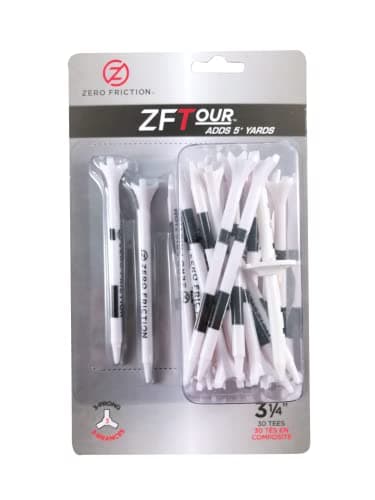
Zero Friction Zero Friction Tour 3-Prong Golf Tees (30 count, 3-1/4 in)
Zero Friction Tour 3-Prong Golf Tees (30 count, 3-1/4 in)

A three-prong top that holds the ball on less material, sold on the idea that less contact means less resistance. Durable and pleasant to use; the distance claim is not something independent testing supports.

A plastic tee that lasts, if you like the three-prong top
6.6
$6.99Amazon
05
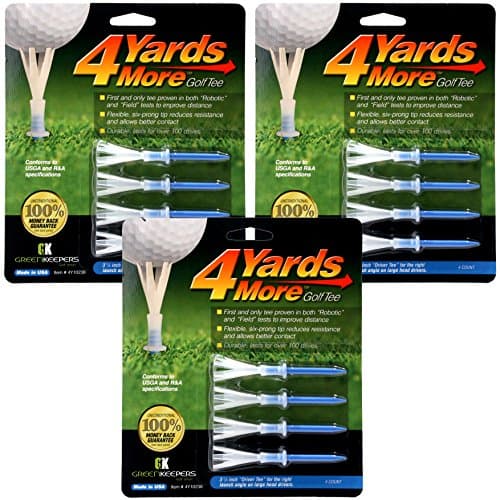
4 Yards More 4 Yards More Golf Tees (12 tees, 3-1/4 in)
4 Yards More Golf Tees (12 tees, 3-1/4 in)

The tee with a distance number in its name, and the one independent testing has looked at most closely. The flexible prong crown is genuinely durable; the extra yards are not in the data.

A tee that survives a season of range work
5.6
$18.79Amazon
06
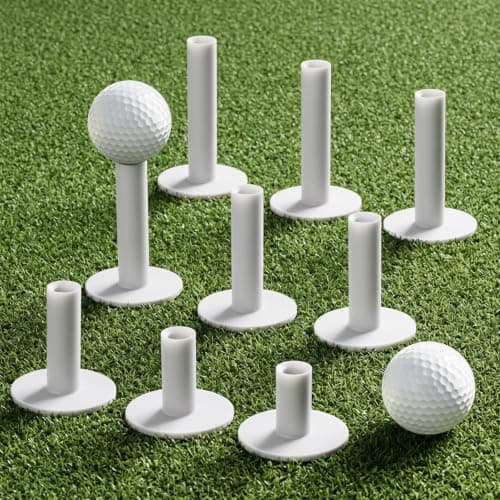
Generic Rubber Golf Tees for Mats (9-piece, mixed sizes)
Rubber Golf Tees for Mats (9-piece, mixed sizes)

Not a course tee at all — the rubber plugs that let you tee a ball on a hitting mat without destroying a wooden tee every swing.

Home mats, simulators and range bays
8.8
$8.99Amazon

#ad · Live prices from the Amazon Product API, as of November 12, 2026. Where we have no verified live price, we show none — we would rather leave a gap than print a number that has rotted.

In detail

The picks, in full

01
Pride PrideSports PTS Wood Golf Tees (135 count, 3-1/4 in)

Almost everyone, almost all the time

PrideSports PTS Wood Golf Tees (135 count, 3-1/4 in)

Hardwood3-1/4 in135 per boxDriver and fairway-wood height
7.6/10

The plain wooden tee, bought in a box big enough to last a season. Independent testing has never found an alternative tee that beats wood, which makes this the category's value answer.

Cost per tee
9
Durability
5
Height consistency
5
Tested performance
9
Value
10

Pros

  • Wood is the control every tee test is measured against, and no published test we can find has beaten it — so you are not paying for an unproven claim
  • A box this size is a season or more of tees for most golfers, which puts the cost per tee below any novelty tee on the market
  • 3-1/4 inches is the standard height for a large-head modern driver, and the length most teaching pros start you at

Cons

  • Wooden tees break. That is the deal you accept for the price, and it is why the box holds 135 of them
  • No height marking, so a repeatable tee height is on you unless you learn a reference point on the tee itself
  • Nothing clever about it — if you want a tee that does something, this is not that tee

Don't buy this if…

…you specifically want a fixed, repeatable tee height every single time. A step-down castle tee does that job better than any smooth tee, wooden or plastic.

$14.99View on Amazon

Price as of November 12, 2026. Prices change — Amazon's is the one that counts.

#ad · we may earn a commission from this link to PrideSports PTS Wood Golf Tees (135 count, 3-1/4 in)

02
MYKUJA MYKUJA Bamboo Golf Tees (100 count, 3-1/4 in)

The cheapest tee per shot

MYKUJA Bamboo Golf Tees (100 count, 3-1/4 in)

Bamboo3-1/4 in100 per bagColored for visibility in grass
7.8/10

Bamboo instead of hardwood, at the lowest cost per tee on this page. The fiber runs the length of the tee, so it survives more strikes than a soft wooden one.

Cost per tee
10
Durability
6
Height consistency
5
Tested performance
8
Value
10

Pros

  • The lowest cost per tee of anything here, by a wide margin
  • Bamboo's long parallel fibers resist splitting better than the short grain of a cheap wooden tee, so fewer snap on a thin strike
  • Colored shafts are genuinely easier to find in rough after a drive sends the tee flying

Cons

  • Bamboo is stiffer than hardwood, which some players feel as a slightly harsher strike on a fat tee shot
  • Bag-packed rather than boxed, so they arrive loose and a pack usually has a few rejects in it
  • No published length tolerance, so a bag of 100 will vary a little tee to tee

Don't buy this if…

…you only need a dozen tees and you would rather have a named brand. At this price the point of the bag is that you stop thinking about tees for a year.

$8.54View on Amazon

Price as of November 12, 2026. Prices change — Amazon's is the one that counts.

#ad · we may earn a commission from this link to MYKUJA Bamboo Golf Tees (100 count, 3-1/4 in)

03
Generic Castle Step-Down Plastic Golf Tees (100 count, mixed heights)

Beginners and anyone whose tee height wanders

Castle Step-Down Plastic Golf Tees (100 count, mixed heights)

Plastic castle/step designFive heights, 1-1/2 to 2-3/4 in100 per packPush to the step, not by feel
8.4/10

The tee that fixes the one thing in this category that measurably changes a shot: tee height. The step stops at the turf, so every ball starts from the same place.

Cost per tee
8
Durability
8
Height consistency
10
Tested performance
7
Value
9

Pros

  • You push the tee in until the step meets the ground, so the ball sits at the same height every time — the one tee feature with real launch-monitor data behind it
  • Mixed heights in one pack cover an iron, a hybrid, a fairway wood and a driver without guessing
  • Plastic survives far more strikes than wood, so a 100-pack lasts a long time

Cons

  • The tallest step here is 2-3/4 inches, shorter than the 3-1/4 inch standard many large-head drivers want — check your current height before switching
  • Unbranded and sold under several seller names, so the exact plastic and colorway can change between orders
  • Plastic tees are harder to push into baked summer turf than a sharp wooden tee

Don't buy this if…

…you tee a driver high. The tallest step is under 3 inches, so a high driver tee shot wants the 3-1/4 inch wood or bamboo tee instead.

$9.99View on Amazon

Price as of November 12, 2026. Prices change — Amazon's is the one that counts.

#ad · we may earn a commission from this link to Castle Step-Down Plastic Golf Tees (100 count, mixed heights)

04
Zero Friction Zero Friction Tour 3-Prong Golf Tees (30 count, 3-1/4 in)

A plastic tee that lasts, if you like the three-prong top

Zero Friction Tour 3-Prong Golf Tees (30 count, 3-1/4 in)

PlasticThree-prong top3-1/4 in30 per pack
6.6/10

A three-prong top that holds the ball on less material, sold on the idea that less contact means less resistance. Durable and pleasant to use; the distance claim is not something independent testing supports.

Cost per tee
5
Durability
9
Height consistency
8
Tested performance
5
Value
6

Pros

  • One of the longest-lasting tees you can buy — a single tee survives dozens of drives, so a 30-pack goes a long way
  • The prongs cradle the ball steadily in wind, which is a small real annoyance solved
  • Molded to a consistent length, so your tee height repeats better than it does with wood

Cons

  • The reduced-friction distance claim does not survive independent testing: MyGolfSpy's tee work found no reliable evidence that alternative tees beat a plain wooden one
  • Costs several times more per tee than wood or bamboo
  • Plastic tees bend rather than break, and a bent prong sits the ball crooked until you notice

Don't buy this if…

…you are buying it for yards. Buy it because it lasts; the wooden tee is the honest pick if the goal is cost per shot.

$6.99View on Amazon

Price as of November 12, 2026. Prices change — Amazon's is the one that counts.

#ad · we may earn a commission from this link to Zero Friction Tour 3-Prong Golf Tees (30 count, 3-1/4 in)

05
4 Yards More 4 Yards More Golf Tees (12 tees, 3-1/4 in)

A tee that survives a season of range work

4 Yards More Golf Tees (12 tees, 3-1/4 in)

Flexible prong crown3-1/4 in12 per packReusable design
5.6/10

The tee with a distance number in its name, and the one independent testing has looked at most closely. The flexible prong crown is genuinely durable; the extra yards are not in the data.

Cost per tee
3
Durability
9
Height consistency
8
Tested performance
4
Value
4

Pros

  • Long-lived: the flexible crown deforms instead of snapping, and a single tee can last weeks of practice
  • The prongs hold the ball high and steady, which helps if you tee a driver up near the crown
  • Length is molded and repeatable, unlike a wooden tee you push in by feel

Cons

  • The name is a performance claim the testing does not support — MyGolfSpy's tee test put it statistically identical to a wooden tee
  • By far the highest cost per tee here, which is a strange place to land for a product sold on a value promise
  • Twelve tees is not many if you are the sort of golfer who loses them

Don't buy this if…

…you want the four yards. There is no measured evidence of them, and a box of wooden tees costs a fraction of this for the same result.

$18.79View on Amazon

Price as of November 12, 2026. Prices change — Amazon's is the one that counts.

#ad · we may earn a commission from this link to 4 Yards More Golf Tees (12 tees, 3-1/4 in)

06
Generic Rubber Golf Tees for Mats (9-piece, mixed sizes)

Home mats, simulators and range bays

Rubber Golf Tees for Mats (9-piece, mixed sizes)

RubberNine mixed heightsFor mat tee holesEffectively unbreakable
8.8/10

Not a course tee at all — the rubber plugs that let you tee a ball on a hitting mat without destroying a wooden tee every swing.

Cost per tee
9
Durability
10
Height consistency
9
Tested performance
7
Value
9

Pros

  • A wooden tee in a mat snaps on the first fat strike; these do not break at all, which is the entire point
  • Nine heights means you can match driver, hybrid and iron practice instead of hitting everything off one height
  • One of the few pieces of practice kit that genuinely never needs replacing

Cons

  • Only works with a mat that has a tee hole — a solid turf mat or a net without a mat does nothing with these
  • Rubber is more forgiving than real turf, so a drive teed off rubber tells you less about your strike than grass does
  • Unbranded, with no published hardness or tolerance, so the sizes are approximate

Don't buy this if…

…you only play on grass. These are practice hardware; a box of wooden tees is the right answer on the course.

$8.99View on Amazon

$9.9910% off

Price as of November 12, 2026. Prices change — Amazon's is the one that counts.

#ad · we may earn a commission from this link to Rubber Golf Tees for Mats (9-piece, mixed sizes)

Tee height: a practical method

For a driver, the standard reference is to tee the ball so that half of it sits above the crown of the driver when the club is soled behind it. With a modern 460cc head that usually means a 3-1/4 inch tee pushed most of the way in. For a fairway wood or hybrid off the tee, the ball wants to sit only just off the turf, because you are striking it with a descending or level blow — a 2-3/4 inch tee pushed nearly flush, or a castle tee on a low step. For an iron on a par 3, barely a tee at all.

The reason this matters so much on a driver and so little on an iron is where the ball meets the face. High on the face with a slightly upward strike is the low-spin, high-launch combination that produces maximum carry; low on the face is the opposite. MyGolfSpy's height test found the low-tee loss came mainly from low-face contact, which is the same mechanism from the other direction.

Why cost per tee is the only price that matters

This is the one category on this site where the unit economics are so lopsided that they settle the argument on their own. A hundred-count bulk bag works out to pennies a tee; a small pack of performance tees costs a large multiple of that per tee, at the live prices below. For the performance tee to be the better buy, it has to survive somewhere in the region of ten to twenty times as many strikes — which, to be fair, the best plastic tees genuinely can on a mat, and definitely cannot on a course where tees get lost rather than broken.

So the split is not about which tee is better. It is about where the tee dies. On the course, tees are lost, so buy cheap ones in bulk. On a mat, tees are struck, so buy durable ones in small numbers. Getting that one distinction right is worth more than any claim on any package.

The claims, decoded

  • “Reduced friction” / prong tops. The idea is that less tee touching the ball means less energy lost at impact. The theory is plausible; the measured effect in independent testing is not detectable. Buy prong tees for durability and ball stability in wind.
  • “Four more yards.” Tested directly, and the data put it level with wood. It is a durable tee with a marketing name.
  • “Consistent height.” The one claim that holds up, and the one that is easiest to verify yourself: a step either stops at the turf or it does not.
  • Brush tees. Bristles instead of a cup. The same reduced-contact theory, the same absence of measured gain; they are, however, close to unbreakable.

Where the money actually goes

Tees are a rounding error on a golf budget, which is exactly why they are a good test of whether a brand is selling you performance or a story. If a company will print a distance number on a product that independent testing finds level with a piece of wood, read its other claims with the same eye. The same test applies at the other end of the bag: our are expensive golf balls worth it page runs the argument on the category where the premium is sometimes defensible, and best golf balls for distance is where the yards you were hoping to buy from a tee are actually available.
How we picked

We do not run a testing lab

We compiled the published specifications, did the cost-per-round and value math, and read the independent robot and launch-monitor data — then scored each product against a published rubric. The scores are judgments from documented research — they are not measurements we took, because we do not have a lab and we are not going to pretend we do. Where a number came from someone else's lab, we name them and link them in Sources.

Questions

Frequently asked

What are the best golf tees?
For almost everyone, a large box of 3-1/4 inch wooden tees — the independent testing has never found an alternative tee that beats wood for performance, so the cheapest reliable tee wins. If your tee height varies from shot to shot, step-down castle tees are the one upgrade with measured benefit behind them.
Do expensive golf tees add distance?
No measured evidence says so. MyGolfSpy tested FlightPath, Martini and 4 Yards More tees against a wooden tee at 120 drives each and found no reliable evidence of a significant benefit over wood. Premium tees do last much longer, which is a real reason to buy one — just not a distance reason.
What length golf tee should I use for a driver?
3-1/4 inches is the standard for a modern large-head driver, teed so about half the ball sits above the crown. Shorter tees around 2-3/4 inches suit fairway woods and hybrids, and an iron off a par 3 needs barely any tee at all.
Does tee height affect distance?
Yes, and it is the one part of this category that genuinely does. MyGolfSpy's tee height test measured about 14.19 yards more carry and 14.66 yards more total distance from a 1.5-inch tee height versus 0.5 inches, with launch about 3.54 degrees higher — largely because the low tee produced low-face strikes.
How long can a golf tee legally be?
Four inches (101.6 mm) total, under the USGA equipment rules — and that is overall length, not the part sticking out of the ground. A tee also must not be built to indicate the line of play or unduly influence the ball's movement, which is what rules out novelty tees with alignment features.
Are plastic golf tees better than wooden ones?
They last much longer and hold a more repeatable height, which matters on a practice mat. They cost several times more per tee and perform the same as wood in testing, so for course play — where tees are lost more often than broken — wood or bamboo in bulk is the better buy.

Keep reading

Receipts

Sources

We do not run a testing lab, and we do not pretend to. Where a measured number came from someone else's lab or robot, we name them and link them. Where we could not verify something, we say so on the page rather than quietly leaving it out. Read our full method.