Skip to content
Club&Carry

Hub 05 · Tech & Gadgets

The Best Golf Hitting Mats

The mat is the part of a home setup that decides whether practice helps you or hurts your wrists.

By Stephen V.Updated How we pick
#ad

We earn a commission when you buy through our Amazon links, at no extra cost to you. It never affects our rankings, and we say so when the cheaper product is the better buy. How this works.

The GoSports Elite is the hitting mat to buy if you have the floor space: five feet by four, with 15 mm turf and enough area that you stand on the mat rather than beside it. If you want to practice more than one lie, the Champkey Tri-Turf gives you three surfaces in a portable size. Our budget pick is the Champkey Heavy-Duty pad — the cheapest honest way to start hitting balls at home. And whichever you buy, add rubber mat tees: wooden tees do not go into a mat.

Our hub already ranks nets and mats together on best golf practice nets and mats, because most people buy both at once. This page splits the mat out, because the mat is where the decisions are, and because the two specs that matter — hitting area and turf depth — get lost in a page that also has to talk about netting.

Turf depth, and the injury nobody advertises

A real fairway gives way. A club that arrives slightly fat takes a divot and the turf absorbs the energy. A thin mat on a concrete garage floor does the opposite: the club bounces, the shock travels up the shaft into your hands, and you feel it in your lead wrist and your lead elbow. Golfers call it mat elbow and it is the single most common reason a home setup gets abandoned after a month.

Two things prevent it. The first is turf depth — more fibre between the clubhead and the base, which is why a published figure like 15 mm is worth paying for over an unstated one. The second is what the mat sits on: a rubber-backed mat on a carpeted floor or a sheet of plywood with a foam underlay behind it is far kinder than the same mat on bare concrete. Neither of these is a product claim. They are the physics of the thing, and they are why the cheapest pad here is listed as the way to start rather than the way to practice for years.

Hitting area: do you stand on it?

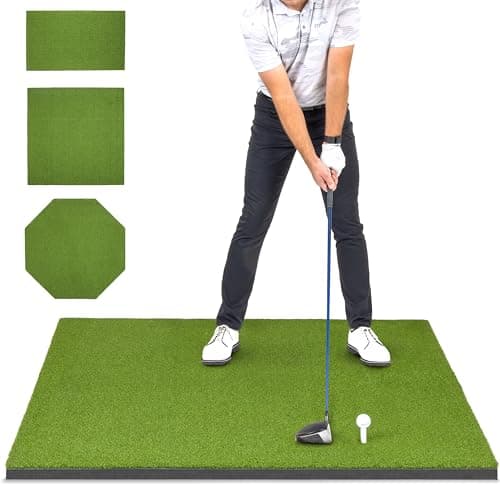
This is the spec most buyers get wrong, because it sounds like a convenience question and it is actually a swing question. If the mat is only big enough for the ball and your stance is on the floor beside it, you are swinging from a surface that is one or two centimetres lower than the ball. That changes your low point, and you will groove a compensation for a lie you will never face on a course.

A mat around five feet by four lets both feet and the ball sit on the same plane, which is the whole reason to pay for the bigger one. A small pad is fine for a chipping drill, a launch monitor session where you only need carry numbers, or a bay where you already stand on turf.

Published specs, side by side

Live prices for each mat, with a per-row buy link and the date each price was checked, are in the Quick Picks table above. Where a listing does not publish a turf depth, we say so rather than estimating one.

MatSizeTurf depthStance on mat?
GoSports Elite5 x 4 ft15 mmYes
Champkey Tri-TurfPortable, three turf panelsNot publishedNo
Champkey Heavy-DutyCompact padNot publishedNo
Rubber mat tees (9-piece)Accessoryn/an/a

The three-turf question

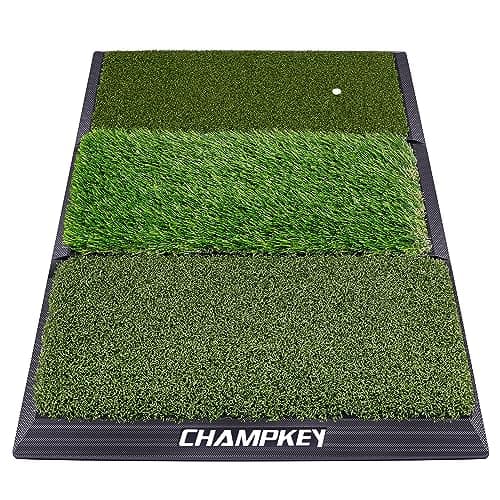
A tri-turf mat gives you a fairway-length panel, a rough-length panel and a tee panel in one portable mat. It is genuinely useful for one thing: learning how differently the ball comes out of thicker grass, which is a shot most amateurs guess at. It is not a substitute for a full-size mat, because none of the three panels is big enough to stand on, and the seams between them are not somewhere you want to catch a club.

Buy it as a second mat or as a travel mat. Buy the five-by-four as your main one.

Why rubber tees are not optional

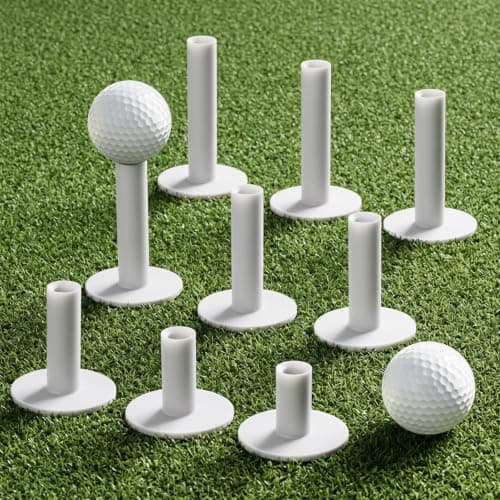
A wooden tee needs ground to go into, and a mat has none. Every mat here either includes rubber tees or has holes for them, and a nine-piece mixed-height set costs less than a sleeve of balls. Mixed heights matter more than they sound: our best golf tees page covers the published MyGolfSpy tee-height test, which measured about 14 yards more carry from a 1.5-inch tee than a 0.5-inch one with a driver. If every practice swing at home is off a one-height rubber plug, you are rehearsing one tee shot.

What to buy in what order

  1. The mat, sized to the space you actually have. Measure the ceiling too: a full driver swing needs considerably more height than people assume.
  2. Something to hit into. A net, or a garage wall you are prepared to replace. Our nets and mats page ranks the one net in our catalog.
  3. Rubber tees in mixed heights. Cheapest item on the list, and the one that makes driver practice representative.
  4. Numbers, last. A launch monitor turns hitting balls into practice, and our best launch monitors page starts well below what most people expect. Our are cheap golf simulators worth it page is worth reading before you spend on software.

And one thing to skip: do not start with the most expensive mat you can afford if you are not yet sure you will use it. A cheap pad and a net in the garage for one winter tells you whether you are a person who practices at home. Most people find out they are not, and the honest version of this page says so before taking your money.

Already own a net? Our best golf hitting matspage ranks the mats on their own, on published hitting area and turf depth — the two specs that decide whether home practice helps you or hurts your wrists.

The mat is the part of a home build people under-spend on and regret. Our best golf hitting mats page covers hitting area, turf depth and why a thin mat on concrete is the one purchase here that can injure you.

Shopping under a hundred dollars? Our best putting mats under $100 page applies that ceiling to the live feed, which turns this into a straight choice between mat length and surface speed.

If putting is where your shots are going, start with the surface rather than the aid. Our best putting mats under $100 page ranks the mats worth owning, and the pressure trainer here needs one to be worth anything.

Comparing against a SkyTrak specifically? Our SkyTrak alternatives page sets out what that unit is known for and which of these five delivers the part of it you actually wanted.

If the unit you had in mind was a SkyTrak, our SkyTrak alternatives page covers the cheaper routes to spin data and simulated rounds, and our best golf hitting mats page covers the surface every build needs.

Both of these come up most often as SkyTrak substitutes. Our SkyTrak alternatives page puts them alongside the three radar units with their own screens, with the published specs for each.
The short answer

Quick picks

#ProductBest forScorePrice
01
GoSports GoSports Elite Golf Hitting Mat (5 x 4 ft)
GoSports Elite Golf Hitting Mat (5 x 4 ft)

A full stance-and-strike mat with enough turf depth to hit down on the ball without punishing your joints. The one to buy if you practice seriously.

Real, repeatable home practice
8.2
$149.99Amazon
02
Champkey Champkey Tri-Turf Golf Hitting Mat
Champkey Tri-Turf Golf Hitting Mat

Three lie types on one mat — fairway, rough and a tee box. The most useful practice surface per dollar on this page.

Practicing more than one lie
6.8
$44.99Amazon
03
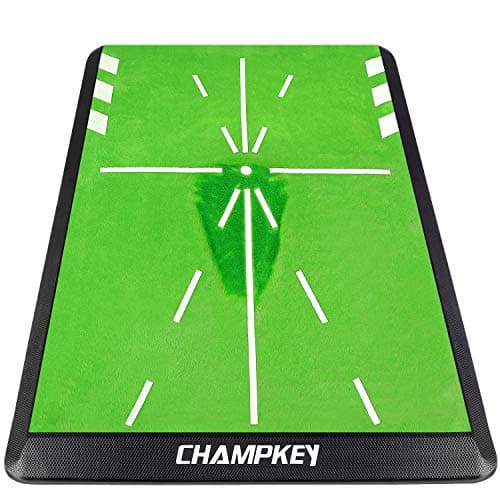
Champkey Champkey Heavy-Duty Golf Hitting Mat
Champkey Heavy-Duty Golf Hitting Mat

A twenty-dollar turf pad that turns any flat surface into a place you can hit balls. The cheapest real practice you can buy.

The lowest-cost way to start hitting at home
5.8
$19.99Amazon
04
Generic Rubber Golf Tees for Mats (9-piece, mixed sizes)
Rubber Golf Tees for Mats (9-piece, mixed sizes)

Not a course tee at all — the rubber plugs that let you tee a ball on a hitting mat without destroying a wooden tee every swing.

Home mats, simulators and range bays
8.8
$8.99Amazon

#ad · Live prices from the Amazon Product API, as of November 12, 2026. Where we have no verified live price, we show none — we would rather leave a gap than print a number that has rotted.

In detail

The picks, in full

01
GoSports GoSports Elite Golf Hitting Mat (5 x 4 ft)

Real, repeatable home practice

GoSports Elite Golf Hitting Mat (5 x 4 ft)

5 x 4 ft15 mm turfStance included3 rubber tees
8.2/10

A full stance-and-strike mat with enough turf depth to hit down on the ball without punishing your joints. The one to buy if you practice seriously.

Turf feel
8
Joint comfort
8
Durability
8
Size
10
Value
7

Pros

  • Big enough to stand on, which means your practice stance matches your course stance
  • 15 mm turf absorbs a descending strike far better than a thin pad
  • Pairs directly with the GoSports net for a complete home bay

Cons

  • Heavy and awkward — this is a mat that lives in one place
  • Costs more than the net it pairs with

Don't buy this if…

…you live in an apartment or practice occasionally. This is a garage or garden fixture, not something you put away after each session.

$149.99View on Amazon

Price as of November 12, 2026. Prices change — Amazon's is the one that counts.

#ad · we may earn a commission from this link to GoSports Elite Golf Hitting Mat (5 x 4 ft)

02
Champkey Champkey Tri-Turf Golf Hitting Mat

Practicing more than one lie

Champkey Tri-Turf Golf Hitting Mat

Three turf typesRubber backingPortable sizeRubber tee included
6.8/10

Three lie types on one mat — fairway, rough and a tee box. The most useful practice surface per dollar on this page.

Turf feel
7
Joint comfort
6
Durability
7
Size
5
Value
9

Pros

  • A rough section is genuinely valuable — nobody practices from rough and everybody plays from it
  • Thicker than the basic pad, so it is kinder on the wrists
  • Light enough to carry to the garden and back

Cons

  • Each turf section is small; you get one lie type per swing and have to move the ball
  • Still not a full-size stance mat — you stand on the ground beside it

Don't buy this if…

…you want to stand on the mat as well as hit off it. Only the big GoSports Elite here is large enough for that.

$44.99View on Amazon

Price as of November 12, 2026. Prices change — Amazon's is the one that counts.

#ad · we may earn a commission from this link to Champkey Tri-Turf Golf Hitting Mat

03
Champkey Champkey Heavy-Duty Golf Hitting Mat

The lowest-cost way to start hitting at home

Champkey Heavy-Duty Golf Hitting Mat

Compact padRubber backingSwing-path feedback surfaceIncludes tees
5.8/10

A twenty-dollar turf pad that turns any flat surface into a place you can hit balls. The cheapest real practice you can buy.

Turf feel
5
Joint comfort
4
Durability
6
Size
4
Value
10

Pros

  • Costs less than a bucket of range balls twice over and never runs out
  • The rubber backing actually stays put on concrete rather than sliding on the first swing
  • Small enough to store behind a door, which is why it gets used

Cons

  • The pad is small, so a mishit finds the floor underneath it
  • Thin turf transmits more shock to the wrists than a thick mat

Don't buy this if…

…you have wrist or elbow trouble. Thin mats are the classic cause of golfer's elbow — pay for the thicker Champkey Tri-Turf or the GoSports Elite instead.

$19.99View on Amazon

Price as of November 12, 2026. Prices change — Amazon's is the one that counts.

#ad · we may earn a commission from this link to Champkey Heavy-Duty Golf Hitting Mat

04
Generic Rubber Golf Tees for Mats (9-piece, mixed sizes)

Home mats, simulators and range bays

Rubber Golf Tees for Mats (9-piece, mixed sizes)

RubberNine mixed heightsFor mat tee holesEffectively unbreakable
8.8/10

Not a course tee at all — the rubber plugs that let you tee a ball on a hitting mat without destroying a wooden tee every swing.

Cost per tee
9
Durability
10
Height consistency
9
Tested performance
7
Value
9

Pros

  • A wooden tee in a mat snaps on the first fat strike; these do not break at all, which is the entire point
  • Nine heights means you can match driver, hybrid and iron practice instead of hitting everything off one height
  • One of the few pieces of practice kit that genuinely never needs replacing

Cons

  • Only works with a mat that has a tee hole — a solid turf mat or a net without a mat does nothing with these
  • Rubber is more forgiving than real turf, so a drive teed off rubber tells you less about your strike than grass does
  • Unbranded, with no published hardness or tolerance, so the sizes are approximate

Don't buy this if…

…you only play on grass. These are practice hardware; a box of wooden tees is the right answer on the course.

$8.99View on Amazon

$9.9910% off

Price as of November 12, 2026. Prices change — Amazon's is the one that counts.

#ad · we may earn a commission from this link to Rubber Golf Tees for Mats (9-piece, mixed sizes)

How we picked

We do not run a testing lab

We compiled the published specifications, did the cost-per-round and value math, and read the independent robot and launch-monitor data — then scored each product against a published rubric. The scores are judgments from documented research — they are not measurements we took, because we do not have a lab and we are not going to pretend we do. Where a number came from someone else's lab, we name them and link them in Sources.

Questions

Frequently asked

What is the best golf hitting mat for home use?
The GoSports Elite, if you have the room: five feet by four with 15 mm turf, so both feet and the ball sit on the same surface. That matters more than any other spec, because a mat too small to stand on puts your stance lower than the ball and teaches you a compensation.
Do golf hitting mats hurt your wrists?
Thin ones on hard floors can. Real turf absorbs a slightly fat strike; a thin mat on concrete bounces the club and sends the shock into your lead wrist and elbow. Deeper turf helps, and so does what the mat sits on — plywood with foam under it, or carpet, rather than bare concrete.
What thickness should a golf hitting mat be?
Thicker is better, and a published figure beats an unstated one — the GoSports Elite states 15 mm of turf, while the cheaper pads here publish no depth at all. If a listing will not tell you the turf depth, assume it is thin and plan to put something forgiving underneath it.
Can you use real golf tees on a hitting mat?
No — a wooden tee needs ground to push into. Use rubber tees, which either come with the mat or push into holes in it, and buy a mixed-height set rather than one plug. MyGolfSpy's tee-height testing measured roughly 14 yards more carry from a 1.5-inch tee than a 0.5-inch one with a driver, so practicing off a single height rehearses a single shot.
Are tri-turf golf mats any good?
For one specific job, yes: learning how the ball comes out of rough-length versus fairway-length turf, which most amateurs guess at. They are not a replacement for a full-size mat, because no single panel is large enough to stand on and the seams are not a place you want to catch a club. Treat it as a second or travel mat.
How much space do you need for a golf hitting mat?
Floor space is the easy part — a five-by-four mat plus room to swing. Ceiling height is what catches people: a full driver swing needs considerably more headroom than a garage typically offers, and the usual fix is practicing irons indoors and saving the driver for the range or an outdoor net.

Keep reading

Receipts

Sources

We do not run a testing lab, and we do not pretend to. Where a measured number came from someone else's lab or robot, we name them and link them. Where we could not verify something, we say so on the page rather than quietly leaving it out. Read our full method.