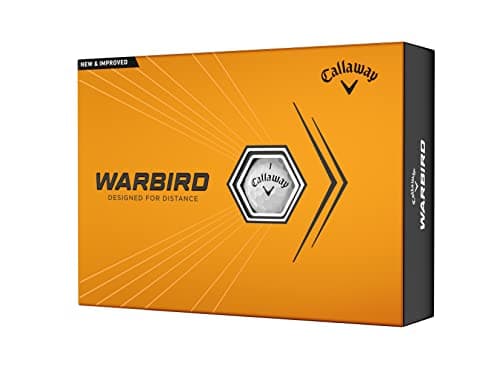
The Warbird is the right ball if you swing moderately, launch the ball low, and want the cheapest way to add carry. It is the wrong ball if you are trying to hold a green with a wedge. Callaway has kept this name alive for three decades for a reason, and the reason is a very large core.
What Callaway actually built
The Warbird is a two-piece ball with an unusually large, low-compression core under a firm ionomer cover. Callaway's stated design intent is high launch and low spin off the long clubs, and the construction delivers exactly that: a big core stores more energy at moderate swing speeds, while the firm cover keeps driver spin down so the ball does not balloon.
The dimple pattern is Callaway's HEX-derived aerodynamic package, which is genuinely unusual at this price. Most balls in the cheap tier use a generic spherical dimple layout; the Warbird gets a version of the pattern Callaway developed for its premium line. That is the engineering you are getting for your money, and it is not nothing.
Who it is for
The Warbird suits a specific, common golfer: moderate clubhead speed, a tendency to hit the ball low, and a game where getting the ball in the air and down the fairway matters far more than stopping a wedge. That describes a very large share of amateur golfers, particularly seniors and improving mid-handicappers.
It also suits a slicer, for the reasons set out on our balls for a slice page — the firm cover produces less total spin, so a tilted spin axis produces less curve. That is why the Warbird tops that list too.
Where it costs you
Greenside, and there is no way around it. An ionomer cover cannot grip wedge grooves the way urethane does. A full wedge shot with a Warbird will land and release rather than check, and a delicate chip will run out further than you expect. If your short game is the strong part of your golf, this ball actively works against you.
Feel is the second cost. The Warbird is firm — noticeably firmer off the putter than a Titleist TruFeel or a Callaway Supersoft. Some golfers like the feedback of a firm ball on the greens; plenty do not. It is worth knowing before you buy a case rather than after.
How it compares to the other cheap distance balls
Against the Titleist Velocity, the Warbird launches higher and feels softer, while the Velocity is firmer and faster off the face for a quicker swing. Against the TaylorMade Distance+, the two are closely matched, with the Warbird the higher launcher and the Distance+ the firmer feel.
Against its own stablemate the Supersoft, the answer is easier: the Supersoft is a soft ball that suits slower swings wanting feel, the Warbird is a firm ball that suits moderate swings wanting carry. They are not competitors so much as two different answers.
The value verdict
The Warbird is one of the very few balls where a major manufacturer's genuine aerodynamics research reaches the bottom of the price range. If the profile above matches you — moderate speed, low flight, distance-first priorities — it is an easy recommendation, and buying it in a multi-pack from our bulk roundup is the cheapest form of it.
If you strike your wedges well and want spin, spend the same money on recycled urethane balls instead. Same price, completely different ball, and a far better fit for that game.