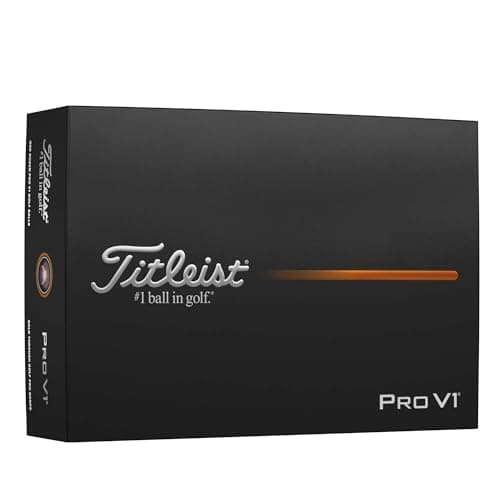
The Pro V1 is the best-made golf ball you can buy, and for most of the people who buy it that is beside the point. Its measurable edge is greenside — about a thousand rpm of wedge spin — and a golfer who cannot use that spin is paying roughly four times the per-ball price of a value urethane ball for a difference they will never see on a scorecard. This review is about where that line sits, with the independent numbers rather than the marketing.
We should be straight about our bias up front, because it cuts both ways. This site exists to redirect money away from equipment that does not pay you back, and the Pro V1 is the most commonly over-bought ball in golf. It is also, by the independent manufacturing data, the most consistent ball in golf — which is a real quality, not a slogan. Both of those things are true at once, and which one matters more depends entirely on your short game.
What the 2025 Pro V1 actually is
The current Pro V1 is a three-piece ball: a fast high-gradient core, a casing layer, and a soft cast urethane elastomer cover, wrapped in a spherically tiled pattern of 388 tetrahedral dimples. Titleist's own language for the design intent is a penetrating, consistent flight with low long-game spin and a softer feel than its stablemate.
That last clause is the part most buyers get wrong, so it is worth stating plainly: the Pro V1 and the Pro V1x are different balls, not grades of the same one. The V1x uses a dual high-gradient core and 348 dimples, and Titleist describes it as flying higher, spinning more and feeling slightly firmer. If you have been buying whichever box the pro shop had, you may have been playing the wrong one of the two for years.
The cover is the expensive ingredient. Cast urethane is soft enough for wedge grooves to grab and tear into, which is what produces the spin that stops a ball on a firm green. Ionomer and Surlyn covers — what nearly every ball in the under-$30 tier uses — are harder, more durable and cheaper, and they cannot do it. Everything else about a premium ball is refinement; the cover is the mechanism.
The manufacturing story is the underrated part
MyGolfSpy's Ball Lab cuts balls apart and measures them, and the Pro V1 is the ball it calls the most consistently manufactured in the industry — which is why MyGolfSpy uses it as the control ball in its own robot testing. In the 2026 Ball Lab data the Pro V1 gauged at about 92.5 compression, its unit-to-unit consistency ranked in the top ten of the 106 balls in the database, and the sample showed only a 5.3-point compression spread between its firmest and softest ball.
Why care? Because consistency is the quality a good player feels and a cheap ball cannot fake. If every ball in the box is dimensionally and dynamically the same, your seven-iron number is your seven-iron number. Value balls are often fine on average and wobbly ball to ball, and the wobble is invisible until you are trying to hit a distance rather than a direction. This is the Pro V1's most defensible claim, and it is the one Titleist advertises least.
The numbers: where it wins, and by how much
MyGolfSpy's 2026 robot test ran 48 balls through a driver, a seven-iron and a 35-yard wedge. The cleanest way to read the Pro V1's result is against the value urethane ball everyone compares it to, the Kirkland Signature Performance+, as compiled by BallCaddie from that test data:
- Driver, 102 mph: Pro V1 at 149.8 mph of ball speed against 149.3 mph for either Kirkland — within half a mile an hour — with 2,804 rpm of driver spin. On carry it was three to four yards past both.
- Full sand wedge:Pro V1 at 10,632 rpm against roughly 9,611 to 9,688 rpm. That is about 950 to 1,000 rpm more spin, and it is the Pro V1's real edge.
- 35-yard pitch: Pro V1 at 5,443 rpm against 4,324 to 4,599 rpm — 850 to 1,100 rpm more on the shot that decides whether a ball checks or releases.
Read that honestly and the shape of the ball comes out. Off the tee, a value urethane ball is level with it: half a mile an hour of ball speed is not something a human being can perceive, and three yards sits inside the scatter of your own swing. Around the green, the Pro V1 is genuinely a different ball — a full wedge that spins a thousand rpm more lands and stops rather than lands and runs.
And it is not untouchable even there. In the same 2026 test the Callaway Chrome Tour X led the 35-yard wedge spin field at 5,992 rpm, and the TaylorMade Tour Response out-carried and out-totaled the Pro V1 off both the driver and the seven-iron. The Pro V1 is the benchmark because it is the most consistent and the most complete ball, not because it wins every column.
Who should actually buy it
The honest profile is narrow, and it is about your wedges rather than your driver. Buy the Pro V1 if you can deliver a descending blow with a wedge on command, you play greens firm enough that stopping the ball is a real problem, and you do not lose more than a ball or two a round. Roughly 90 to 105 mph of driver speed is the band the ball is designed around, but swing speed alone is not the test — plenty of 100 mph golfers never put a wedge shot inside fifteen feet, and for them the extra thousand rpm lands in a bunker just as well as it lands on a green.
If you convert up-and-downs, a urethane ball pays you back. If you do not yet, it cannot: there is no mechanism by which greenside spin helps a shot that was never going to finish near the hole. That is the whole argument, and our guide on whether expensive golf balls are worth it walks through it with the rest of the evidence.
Where it costs you
Price, obviously, and the way the price compounds. At roughly four to five dollars a ball against one to two for a good value urethane ball, a golfer losing a sleeve a round is burning the difference into the trees — and the ball in the trees spun exactly as well as the one in the fairway. The cost is not the box; it is the box times how often you lose one.
Durability is the second cost, and it is the direct consequence of the thing you paid for. A soft cast urethane cover scuffs more readily than an ionomer cover, so a Pro V1 that catches a cart path or a bunker rake shows it. Tour players change balls freely; you probably do not.
Then there is the cost almost nobody mentions: buying the wrong one of the two. A fair share of the Pro V1 purchases we would question are not value errors at all, they are fitting errors — a golfer who needs the higher-flying, higher-spinning V1x playing the V1 because the box said Pro V1, or the reverse.
The cheaper routes to the same cover
If the profile above is you and the price is still the problem, there are two legitimate ways to play a urethane ball for far less. The first is a value urethane ball — the Kirkland Signature is the obvious one, and our Kirkland vs Pro V1 comparison puts the two side by side on the same test data used above.
The second is buying Pro V1s secondhand. Recycled and refurbished urethane balls are a real market, and a near-mint used Pro V1 is the identical ball at a fraction of the price — the sensible play for a golfer who wants the cover but loses too many to pay list. Our guide to whether refurbished golf balls are worth it ranks the grades and explains which ones to avoid.
The verdict
The Pro V1 earns its reputation. It is the most consistently built ball in golf, it holds a penetrating flight, and it spins about a thousand rpm more than a value urethane ball on a full wedge. None of that is marketing, and we are not going to pretend otherwise just because this is a value site.
The question is whether you can bank it. If your short game converts, buy it and stop reading. If it does not, buy a value urethane ball or a box of near-mint used Pro V1s, put the saved money toward a lesson or a club fitting, and come back to the Pro V1 when your wedges can spend what it gives you. That is not a knock on the ball. It is the only sequence in which the ball is worth the money.