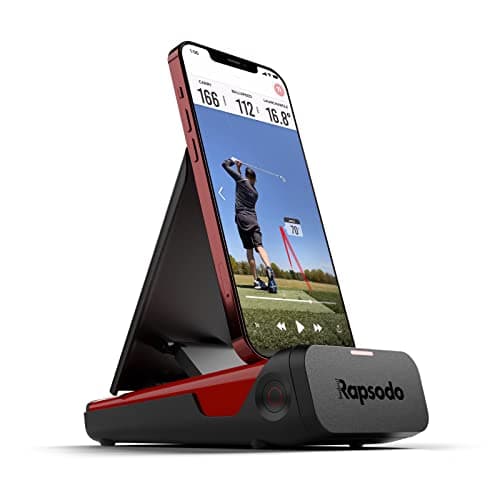
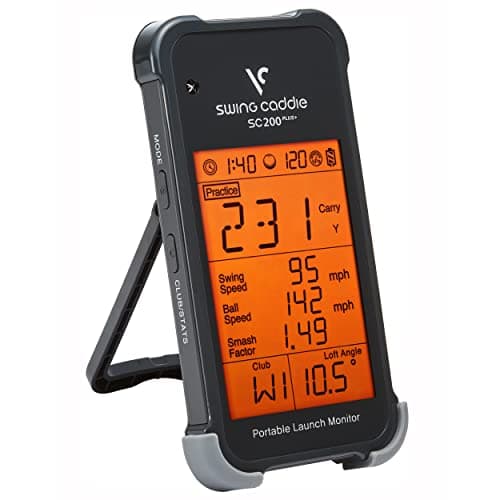
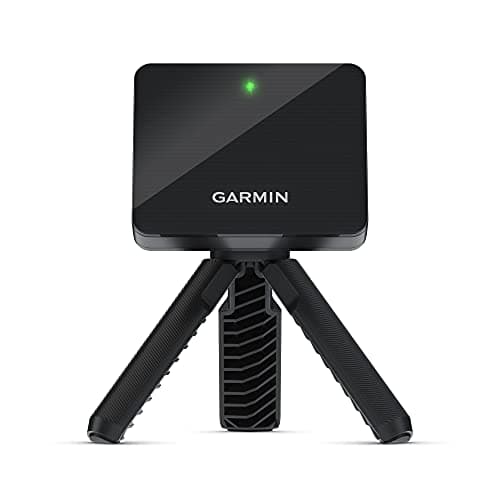
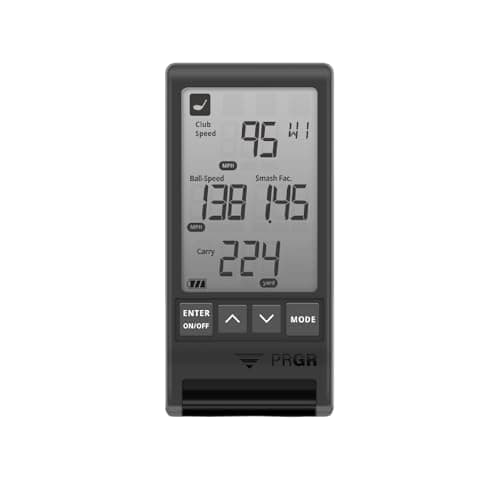
The PRGR HS 130-A is the launch monitor most golfers should buy — club head speed, ball speed, smash factor and carry off a doppler radar, with no phone, no app and no account. If your household is an iPhone household, the Rapsodo MLM costs the same and adds video with a shot tracer. And if you have a room with real ball flight in it, the Garmin Approach R10 is the one worth stretching for: a dozen-plus metrics including spin, and virtual rounds on the same hardware. If those two are the only ones on your shortlist, our Garmin R10 vs Rapsodo MLM comparison settles it, subscriptions included.
The problem a launch monitor actually solves
Ask an average golfer how far they hit a 7-iron and you will get a number from the best one they ever hit, downwind, in July. Ask them the difference between their 8-iron and their 9-iron and you will usually get a guess. That is the gap this category fills, and it is not a swing-fixing gap — it is a club-selection gap. Knowing that your actual carry is 141 yards and not "about 150" changes which club you pull on an approach, and the approach shot is where amateurs leak the most strokes.
That is also why this page exists separately from our budget simulator roundup. A simulator is a room: a monitor, a net or screen, a mat, software and an evening of setup. A launch monitor is the measuring device on its own, and on its own it is the part that does the work. Buy the monitor first, use it at the range for a month, and let the rest of the room follow if you still want it.
One honest caveat before the picks. We have not bench-tested any of these against a tour-level reference unit — we do not own one, and renting range time with a GCQuad is not the same as testing. Every accuracy figure, metric list and space requirement below is the manufacturer's published claim or the live listing, quoted as such. Our methodology page explains exactly what our scores are and are not.
How we picked
Six criteria, applied in this order. Price is the last of them, not the first — a cheap unit that measures nothing useful is not value.
- Measured numbers before modeled ones. Every unit here reports a carry distance, but carry is a calculation. Ball speed is the measurement underneath it, and a radar that reads ball speed well will give you a carry number you can trust relative to your own other clubs, which is what gapping needs.
- It has to work on the phone you own. One of the most recommended units in this category pairs only with an iPhone or iPad. That is not a drawback, it is a hard compatibility wall, and we have ranked it with that stated plainly rather than buried.
- The space it needs is a spec. Radar units measure a ball that is moving away from them. How far behind the ball they sit and how much flight they need in front decides whether a unit works in your garage at all. We treat it as a spec because the box mostly does not.
- What it costs to keep using it. Simulator courses, swing libraries and cloud history sit behind subscriptions on most of this category. We note what each unit does for free, because that is the part you own.
- Verified in stock, at a live price. Every pick was checked against the Amazon catalog on the day this page was written: a title matching brand and model, a real product image and a live in-stock offer. The number on each card is today's, pulled automatically — never a number we typed.
- A ceiling, deliberately. Nothing here is a camera-based photometric system. Those measure spin off markings on the ball rather than inferring it, they are genuinely better, and they start at multiples of the most expensive thing on this page. This is the band where a weekend golfer gets most of the benefit.
The four numbers that matter, and the two that can wait
Every unit on this page gives you the first four. Only the top two give you the rest, and the gap between those two groups is most of the price difference in the category.
- Ball speed. The measurement everything else is built on, and the one number that tells you whether a swing change did anything. More ball speed from the same club head speed is a better strike, full stop.
- Club head speed. Useful on its own for one practical reason: it is the input for choosing a shaft flex, a decision most golfers make from a chart and a guess.
- Smash factor. Ball speed divided by club head speed — strike quality expressed as one number. It is the most useful feedback a cheap unit gives, because it goes up when you find the middle of the face and down when you do not, and it does not care how far the ball went.
- Carry and total distance. The reason most people buy one. Used properly it builds a gapping chart: the real carry of every club in the bag, in order, with the holes in it visible.
- Spin rate. The first thing you gain by spending more. Spin explains why a drive that launched well still fell out of the sky, and why a wedge runs out. It matters a great deal to a fitter and considerably less to a 20-handicap who has not yet built a gapping chart.
- Club path, face angle and angle of attack. Diagnostic numbers that tell you why the ball curved. Genuinely powerful with a coach reading them; close to noise without one, which is the honest argument for starting at the bottom of this page.
Radar, and what it can and cannot do at this price
Everything here is a doppler radar unit. It sits behind or beside the ball, bounces a signal off it and measures the change in frequency as the ball moves away — the same principle as a police speed gun. That gives it a direct read on speed, and the longer it can watch the ball fly, the more it has to work with.
Two consequences follow, and they explain most of the complaints you will read about this category. The first is that radar wants ball flight. Hit into a net from six feet away and the unit sees a fraction of a second of travel, so the numbers it derives from that flight get softer, even when ball speed itself holds up. The second is that spin is the hardest thing to get this way. A photometric camera system photographs a marked ball and reads the rotation directly; a radar at this price either infers spin or tracks it with a tolerance the maker publishes. That is not a scandal — it is the trade you are making, and it is why the two units here that report spin cost two to three times the two that do not.
The practical upshot: at the bottom of this page you are buying a speed-and-distance meter that is at its best outdoors at a range, and at the top you are buying a diagnostic tool that wants a room built around it.
Space: the spec nobody prints on the box
This is the single most common reason a launch monitor ends up unused, and it is worth measuring your garage before you spend anything.
Garmin's guidance for the Approach R10 is the clearest published example: the unit sits roughly six to eight feet behind the ball, and it wants around eight feet of flight in front of it, which adds up to a room deeper than most single garages before you have hung a net. Garmin's recommended indoor space is about ten feet wide, nine feet tall and a little over twenty feet deep, and user guides put the practical floor around fourteen feet of depth. Ceiling height is the quiet killer: nine feet is the comfortable minimum for a full driver swing, and an eight-foot garage ceiling rules out a lot of golfers before any gadget does.
The three standalone units are easier. The PRGR and the SC200Plus sit behind the ball, read the strike and the first part of the flight, and are designed to be used at a range or into a net at home. They still prefer flight to canvas, but they ask for a fraction of the room and none of the cabling. If your practice is a net in a tight garage, that is an argument for the cheap end of this page, not the expensive end — and our nets and mats roundup covers the other half of that setup, including why mat thickness is an injury spec rather than a comfort one.
Phone, no phone, or the wrong phone
This is the compatibility question that catches people out, so here it is in one place.
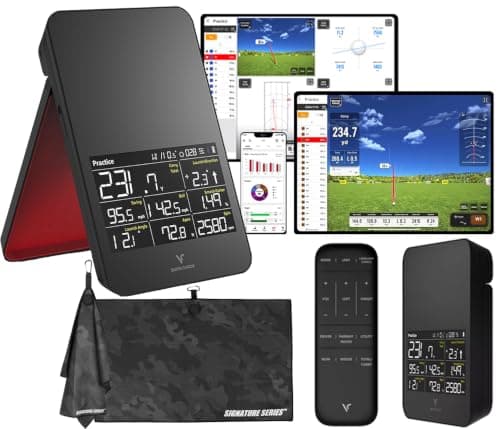
- No phone needed: the PRGR HS 130-A, the Voice Caddie SC200Plus and the Voice Caddie SC4 PRO all display their numbers on the device itself. The two Voice Caddie units also read the distance out loud, which sounds like a gimmick until you have tried to read a screen at your feet between shots.
- iPhone or iPad only: the Rapsodo MLM. It is an outstanding unit for the money and it will not pair with an Android phone at all. Check what is in your pocket before you buy it.
- Either phone, with an asterisk: the Garmin Approach R10 works with the Garmin Golf app on both platforms, but the bundled E6 Connect course set is iOS-only. Android users get the Garmin side of the experience and not the E6 side.
What it costs after you have bought it
Hardware is the first payment in this category, not the only one. The full E6 Connect course library is a paid subscription on top of the R10 and the SC4 PRO, Rapsodo keeps its simulator courses and game modes behind a premium tier, and Voice Caddie's deeper statistics live in its app.
The value rule we apply to every subscription on this site applies here: buy the unit whose free mode is the thing you actually want. If what you want is a gapping chart and better club selection, every unit on this page delivers that for nothing after purchase, and the PRGR delivers it without even an account. If what you want is to play Pebble Beach in your garage in February, you are buying a subscription with a launch monitor attached, and you should price the whole thing before you start.
Who should not buy one at all
Three groups, honestly. A golfer who has never had a lesson will get more from two hours with a coach than from any unit here, because the monitor describes the ball flight you already have — it does not tell you what to change. A golfer who plays twice a year will not use it, and the cheapest gadget is still expensive if it sits in a cupboard. And anyone who only wants to know their carry distances once can get that for free: almost every driving range now has a monitor bay, and most golf retailers will put you on a premium unit for nothing in the hope you buy a club. That is also the honest starting point for whether a fitting is worth it.
What we would actually buy
Most golfers, including anyone buying their first one: the PRGR HS 130-A. It gives you the four numbers that change how you play, it needs nothing but batteries, and it costs what a decent budget rangefinder costs. An iPhone household that wants to see the swing as well as the numbers: the Rapsodo MLM, for the same money, with the video tracer as the deciding feature.
Someone who practices at a range rather than at home, and hates looking at a phone: the Voice Caddie SC200Plus, for the voice output and the practice-swing mode. Someone with a garage deep enough for real ball flight who wants spin and winter rounds: the Garmin Approach R10, which is the best overall device on this page and the one we would stretch for if the room allows. And the golfer who wants spin numbers without building a computer setup around them: the SC4 PRO, bought second rather than first.
Whichever you buy, use the same ball for a session. Range balls fly shorter and spin differently from the ball you play, so a gapping chart built on range rock is a chart of a ball you will never hit on a course. A sleeve of the value ball you actually game is the cheapest accuracy upgrade any of these units can get.