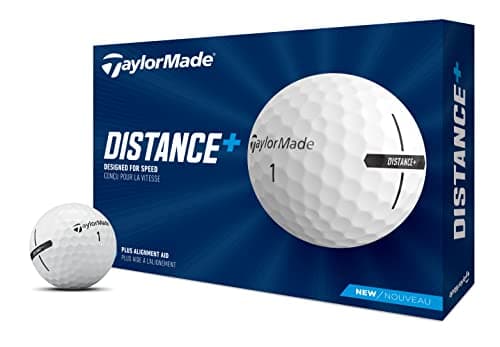
The TaylorMade Distance+ answers one question and one question only: how do I hit it far without spending tour-ball money? It is cheap, fast and long — and it makes no pretense of being anything else.
There is a whole category of golfer whose honest priority off the tee is simple: more carry. Not greenside spin, not a plush putter feel, not the ability to stop a wedge on a dime — just yards, and ideally yards that stay in play. The Distance+ is built for exactly that golfer, and to TaylorMade's credit it does not dress the ball up as something it is not. It uses a fast, resilient core the company calls React Speed, wrapped in a firm, durable ionomer cover, with an extended-flight dimple pattern tuned for a penetrating trajectory. Every one of those choices points the same direction: low spin off the long clubs, high ball speed, and a flight that keeps going. It is a two-piece build, so there is no soft urethane layer inflating the price — for a couple of dollars a ball, that adds up to a lot of distance.
Who the Distance+ is for
Play the Distance+ if carry off the tee is what you are after and you are not relying on the ball for short-game control. It suits a player with a bit of swing speed who fights to keep the ball in the fairway and would happily trade greenside spin for a straighter, longer tee shot — low driver spin means less sidespin, so a slice or a hook curves a little less and the ball chases out toward the target instead of peeling away from it. It also suits the value buyer plainly and simply: this is one of the longer balls you can buy at a genuinely low price per dozen, which makes it a favorite for stocking the bag, for casual rounds with friends, and for anyone who loses enough balls that paying premium prices would sting every time one found the water. It is, in other words, the ball for the player who has made peace with giving up spin to gain yards — a deliberate, honest trade rather than an accidental compromise. If distance is the brief, it delivers on it, and it earns a regular place on our best golf balls for distance ranking.
The standout: distance for the money
The Distance+ does the one job it sets out to do, and it does it cheaply — that is the whole pitch. The fast core and low-spin cover combine into real ball speed and a penetrating, wind-cutting flight that holds its line, and the firm ionomer cover is durable enough to shrug off a cart-path bounce or two without scuffing out of play, so a dozen lasts. There is no soft urethane cover to scuff and shed performance mid-round either, which is part of why a value distance ball ages so gracefully in the bag. What makes it a genuine value standout is not that it is the single longest ball in golf — it is that it gets most of the way there for a fraction of the price of a premium distance ball. For a swing with some speed, the yardage gap between this and a ball costing three times as much is small, and off the tee that narrow gap is the entire reason people talk themselves into overspending. Distance, it turns out, is one of the cheapest things to build well, which is precisely why the value math favors a ball like this one so heavily.
Who should look elsewhere
The trade is spelled out right there in the name: this is a distance ball, so everything else takes a back seat. The feel is firm — some players love the crack off the driver, but it is clicky off the putter and into short irons, and if you prize a soft, plush feel you simply will not find it here. More important, the low-spin design that helps off the tee actively works against you around the green: the Distance+ gives you little help stopping an approach on a firm surface, and it will not check or bite from a full wedge the way a urethane ball does. If you score with your wedges and your putter, this ball is fighting you. A slower swinger should also look elsewhere — you may not compress a firm distance ball enough to unlock its benefit, and a low-compression ball for a slow swing can be both longer and softer for you. And if you want maximum distance with the Titleist name on it instead, the Titleist Velocity is the other big value distance ball worth weighing against this one.
The value verdict
The Distance+ is a specialist, and judged as one it is excellent value: fast, long, durable and cheap, from a brand golfers trust. The only real mistake is buying it for a job it never claimed — expecting soft feel or greenside spin, then coming away disappointed at your own mismatch rather than the ball. Match it to a distance-first game and very few balls give you more carry per dollar. For a huge number of amateurs, that distance-first honesty is exactly what they want from a ball, whatever the marketing for pricier models implies. To see how it holds up on pure value against the other budget bombers and soft-ball bargains, compare it on our best golf balls for the money ranking.