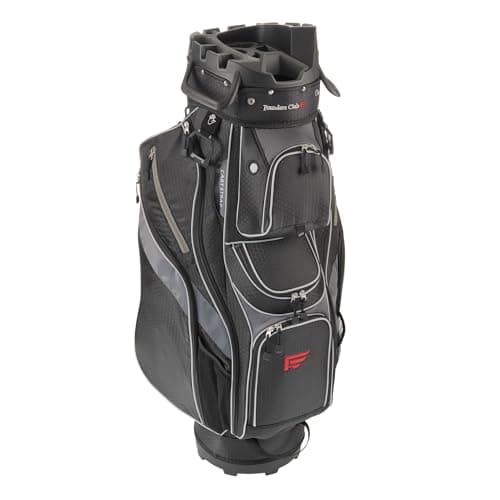
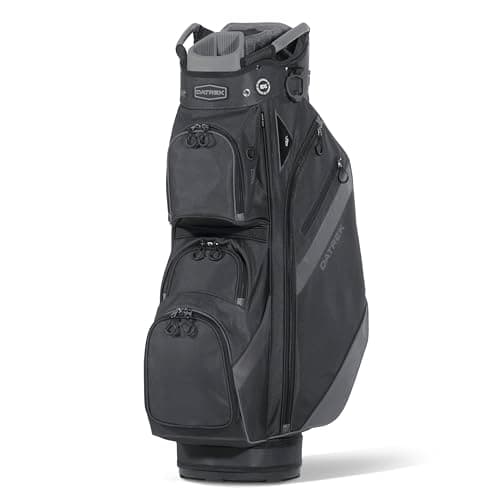
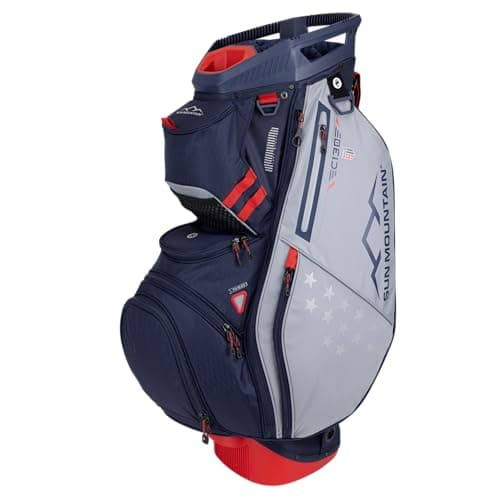
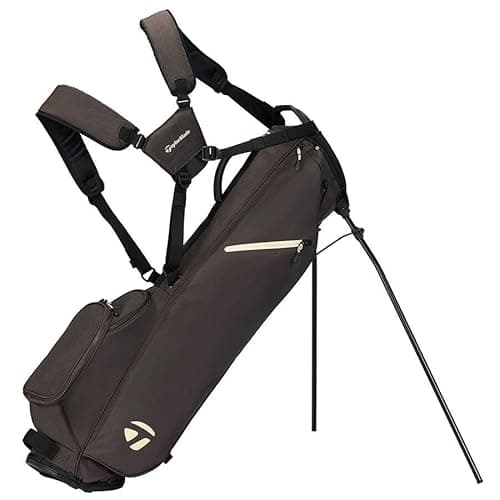
If you walk, buy the TaylorMade FlexTech Carry — a brand-name stand bag with a real dual strap and a self-adjusting leg system, and the cheapest bag here. If you ride or push, the Founders Club Premium Cart Bag is the most storage and organisation per dollar at this tier. Both sit comfortably inside $200. The Datrek DG Lite III and the Sun Mountain C-130 are the two bags that press right up against the ceiling, and they are the ones to buy if you want a 14-way top from a brand that has made the same bag for a decade.
Why $200 is the number that matters
Golf bags are priced from about $60 to about $400, and the curve is not linear. Below roughly $100 you are buying a bag with a short list of real problems: a single thin strap, a flimsy divider top that lets clubs cross and clatter, and zips that fail in the second season. Between $130 and $200 the fundamentals are all present — padded dual straps, full-length dividers, an insulated pocket, a rain hood, a base that does not slide on a cart deck. Above $200 you are mostly buying weight savings, fabric upgrades and a logo.
That makes $200 the honest shopping ceiling for almost everybody. It is also where this site's wider position bites hardest: a bag cannot hit a shot. Every dollar past the point of competence is money not spent on a lesson, a fitting, or the push cart that will do more for your closing holes than any bag ever will.
First, pick the fork — walk or ride
The single most expensive mistake in this category is not overspending; it is buying the wrong type. A cart bag is heavier, has a non-slip base and forward-facing pockets built to be read while the bag is strapped to a frame. A stand bag has legs and a carry harness and is built to be lifted. Carry a 14-way cart bag for 18 holes and you will hate it. Strap a minimalist stand bag to a riding cart and you will spend the round fighting the legs. Our stand vs cart bag guide works through the edge cases; the short version is that you should buy for how you played your last ten rounds, not how you intend to play.
The four bags side by side
| Bag | Type | Divider top | Published weight |
|---|
| TaylorMade FlexTech Carry | Stand | 4-way | About 3 lb |
| Founders Club Premium Cart | Cart | 14-way, full-length | About 7 lb |
| Datrek DG Lite III | Cart | 14-way, full-length | About 5.5 lb |
| Sun Mountain C-130 | Cart | 14-way, full-length | About 6.6 lb |
Every figure in that table comes from the manufacturer's own published specification for the bag, not from our scales. We do not weigh bags; what we can do is read the spec sheet against the job and tell you where it stops mattering. Three of the four are cart bags, and that is not an accident — the sub-$200 tier is where cart bags are strongest, because their weight budget is generous enough that cheap fabric does not hurt them.
What you actually give up under $200
- Weight, if you carry. This is the one real sacrifice. A $300 stand bag can come in around 2 lb empty because it is built from ripstop fabrics and a minimal frame. Under $200 a carry bag lands nearer 3 lb. Over five miles, a pound is noticeable — see best lightweight golf bags if that pound is the thing you care about most.
- Fabric and zip quality. The parts that age are the zips and the base. A premium bag survives ten seasons in a trunk; a value bag survives five. Across ten years that is roughly a wash in money and worse in hassle, which is the honest case for the top of this tier rather than the bottom.
- Pocket count and finish. Fewer small pockets, plainer embroidery, simpler magnetic closures. None of it touches a golf shot.
What you do not give up
Full-length dividers are available at this price — all three cart bags here have them, and they are the spec that actually matters, because a divider that stops halfway down lets your shafts cross and grind at the bottom of the bag. How many dividers you need explains why the count on the box matters less than whether the dividers run the whole way. You also get an insulated drinks pocket, a rain hood, a glove patch and a towel ring on essentially every bag on this list. That is the entire functional feature set of a golf bag.
Who should spend more, and who should spend less
Spend more only for weight: if you carry every round and walk hilly courses, the lightest bag you can afford is a genuine quality-of-life purchase. Spend less — look at the best value bags overall — if you ride in a cart every round and your bag lives in a garage, because at that point the bag is a container and $130 buys a very good container.
One more pairing worth knowing: if you are buying a bag to put on a trolley rather than a shoulder, read whether your bag fits a push cart before you order. Almost all of them do, but the strap span on the biggest 14-way cart bags can be a squeeze on a lightweight frame.
If your budget is the binding constraint rather than the type, the best golf bags under $200 takes the same field and cuts it at the price where a bag stops being a compromise.
Once you have settled the type, the divider count and the strap, the only question left is the number. Best golf bags under $200 is where we think that number should land for almost everybody, and explains what the money above it buys.
Whichever way the fork goes for you, both types are well served under two hundred dollars — best golf bags under $200 ranks a stand pick and three cart picks inside that ceiling.