Nearly every golf bag physically fits nearly every push cart, because carts clamp the bag rather than socket it. What varies is whether the bag sits straight, stays put over bumpy ground, and leaves the pockets you use reachable — and that comes down to top width, base shape and where the strap sits. If you are buying both at once, a stand bag on a three-wheel cart is the pairing with the fewest compromises.
How a push cart actually holds a bag
A push cart is a frame with an upper bracket that cradles the bag below the top cuff and a lower tray that the base sits in, with one or two straps cinching it down. There is no proprietary mount and no standard to comply with. That is why "will it fit" is almost always yes, and why "does it fit well" is almost always worth checking.
Fit problems, when they happen, are one of three things: a bag top too wide for the upper bracket so it rides proud and wobbles, a base too narrow or too rounded to sit squarely in the lower tray, or a bag that sits fine but puts the pocket you reach for most behind a strap. All three are visible in published dimensions before you spend anything.
Measurement 1 — the top cuff width
Cart bags are built for riding carts and tend to have the widest tops in golf — a full 14-way divider top can run noticeably wider than a 4- or 5-way carry bag top. Wide is not disqualifying, but a wide top in a bracket sized for a narrower bag rides higher and rocks more on uneven ground. Travel cases quote this number as a bag-top fit — the Samsonite hard case, for example, publishes a 10.5 in bag-top figure — which is a useful hint that top width is the dimension that varies most across bags.
If you already own a wide 14-way cart bag and you want a cart, prioritize a cart with a generous upper bracket and a long wheelbase. If you are buying both, this is an argument for a stand bag.
Measurement 2 — the base
Cart bags have flat, grippy, cart-optimized bases designed to sit in a riding cart's bay; stand bags have a hinged leg mechanism and a narrower, often rounded foot. Both work on a push cart, but they fail differently. A wide flat base can overhang a small lower tray; a rounded stand-bag base can rotate slightly in a large one until the strap is properly tensioned. Neither is a reason to change bags — it is a reason to tighten the lower strap before the first tee rather than after the third fairway.
Measurement 3 — strap and pocket clearance
This is the one that annoys people daily and nobody checks. Load the bag with the pockets you actually use — balls, rangefinder, water — facing away from the handle, and see whether the upper strap crosses any of them. On a 14-way cart bag with a forward-facing pocket array it usually does not. On a carry bag with a single big front pocket and a dual strap harness, the harness and the cart strap can end up fighting for the same inch. Many walkers simply unclip one side of the carry strap and let it hang; a bag with removable straps makes this a non-issue.
The pairings that work with no thought at all
- Full-size stand bag + 3-wheel cart. The default, and the reason most walkers own exactly this. Nothing overhangs, nothing rocks.
- Lighter 14-way cart bag + long-wheelbase cart. The organization of a cart bag without the width problems of the heaviest ones.
- Minimalist Sunday bag + any cart. Works, and is slightly silly — if the bag is three pounds you did not need the cart.
Two things to check on the cart, not the bag
A long wheelbase is what stops a tall loaded bag feeling tippy on a side-slope, and it matters more than any bracket detail. A real brake matters because a bag that fits perfectly on a cart with no brake still rolls off a tee box. Those two are the features we would not trade for an extra accessory.
If the cart decision itself is still open, our push cart versus carrying guide covers whether to buy one at all, and the push cart roundup ranks the value options.
Why these three
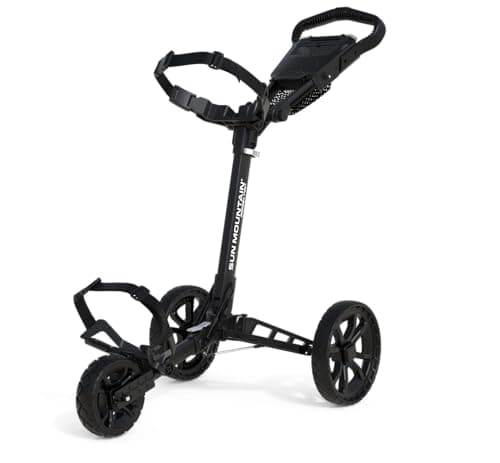
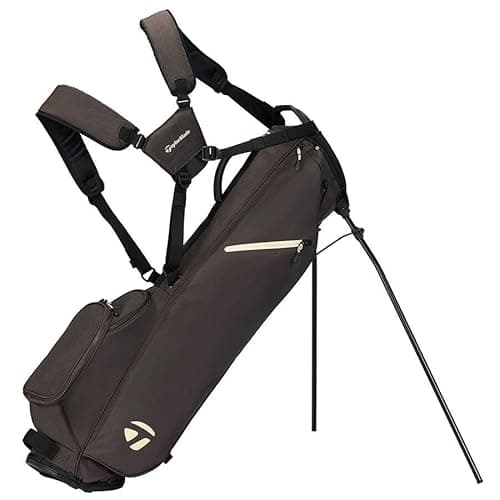
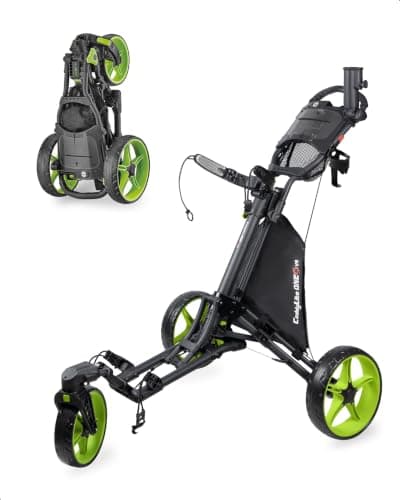
The Caddytek One Swivel V8 publishes a 32 in wheelbase, which is the specification that most directly addresses a tall loaded bag feeling unstable, and its swiveling front wheel is the thing that makes a heavy bag easy to steer. The Sun Mountain Ridgeline positions the bag more vertically to balance the load and uses a handle-mounted brake, which is the easier brake to use mid-walk on a slope. The TaylorMade FlexTech Carry is the full-size stand bag side of the pairing — enough storage to be a real everyday bag, with a stand mechanism that deploys cleanly when it comes off the cart.
| Item | Type | Published detail | Brake / stand |
|---|
| Caddytek CaddyLite One Swivel V8 | 3-wheel push cart | 32 in wheelbase, one-button fold | 360 degree swivel front wheel |
| Sun Mountain Ridgeline | 3-wheel push cart | 18.0 lbs, two-step fold | Integrated hand brake |
| TaylorMade FlexTech Carry | Carry stand bag | Full-size storage, dual strap | FlexTech stand system |
These are published specifications, not our measurements. We have not put a bag on a scale on a cart on a hillside, and we are not going to imply we did.