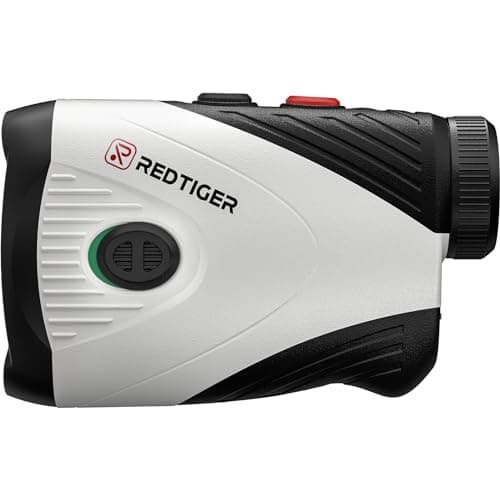
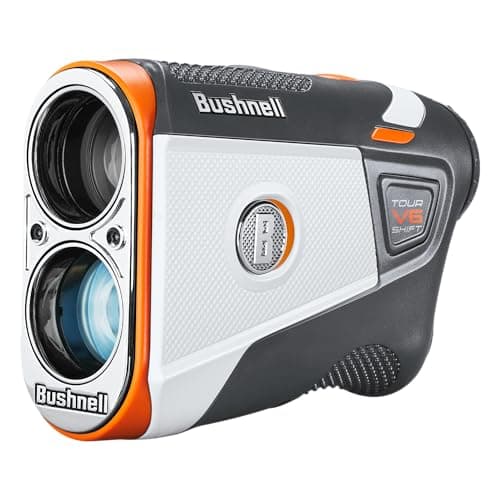
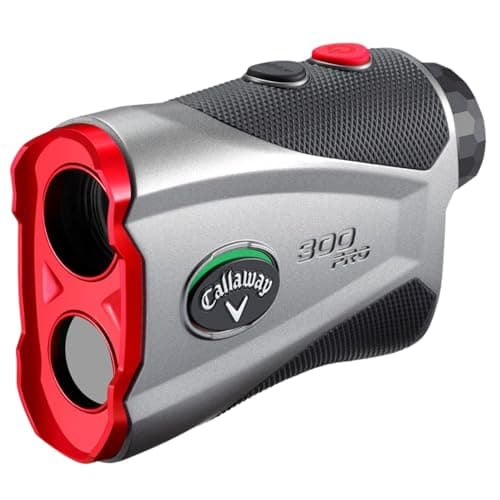
Buy the Callaway 300 Pro. It is the sweet spot: slope with a physical on/off switch, 6x glass, a published range near 1,000 yards and a brand name you can get warranty service from, at a price the premium models double. If you want the cheapest slope unit that is actually worth owning, the REDTIGER sits around $110 with a switch and 7x magnification. The Bushnell Tour V6 Shift is the one to buy if you want the fastest pin lock in golf and are not counting the money.
What slope actually does
A standard rangefinder gives you line-of-sight distance: the straight-line length from you to the flag. On flat ground that is the number you want. On an uphill shot it is not — the ball has to climb, so it plays longer than the straight-line figure, and on a downhill shot it plays shorter.
Slope measures the inclination to the target and does the trigonometry for you, then shows an adjusted "plays like" number alongside the raw one. On a two-club elevation change it is the difference between a shot that finishes pin-high and one that comes up twenty yards short. That is the whole value proposition, and it is real — unlike most of the feature list on a rangefinder box.
The legality rule you must not get wrong
Under the Rules of Golf, a device that measures or adjusts for elevation change is not permitted in competition. A rangefinder with slope is legal in a tournament only if the slope function can be switched off in a way that is obvious — which in practice means a physical switch or a mode the device clearly displays as disabled.
That is why every pick on this page has a switch, and why "slope" models without one are off the list no matter how cheap they are. If you only ever play social golf it does not matter. If you play club competitions, buying a slope-only unit means carrying something you are not allowed to use. Do I need slope? works through whether the feature is worth it for how you play at all.
The five, side by side
| Model | Slope switch | Magnification | Published range |
|---|
| Callaway 300 Pro | Yes | 6x | About 1,000 yd |
| REDTIGER | Yes | 7x | Up to 1,200 yd |
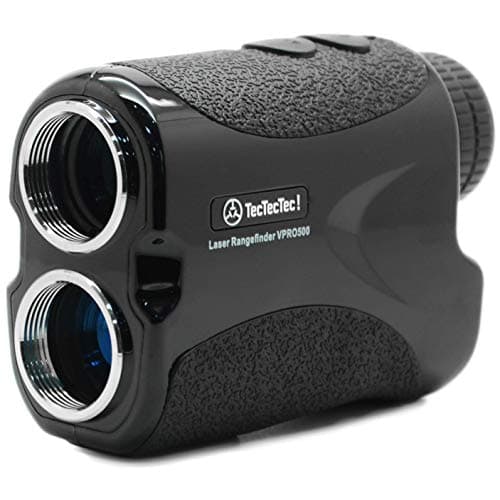
| TecTecTec VPRO500 (Slope) | Slope version | 6x | About 540 yd |
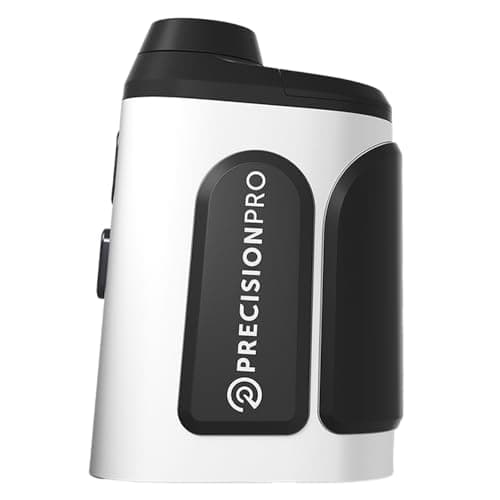
| Precision Pro NX10 | Yes (adaptive slope) | 6x | About 600 yd |
| Bushnell Tour V6 Shift | Yes (tournament-legal mode) | 6x | About 450 yd to flag |
Every figure in that table is the manufacturer's own published specification. We did not laser a flag 1,200 yards away to check; nobody has, because the long-range numbers are measured against a reflective target and have nothing to do with golf. What matters on a golf course is whether the unit locks a flag at 150 yards in bright light, and at that distance all five do.
Where the money stops buying anything
The honest ranking of what you get as the price climbs from $100 to $350:
- Lock speed and confidence — real. The cheapest units take a second or two longer and occasionally grab a tree behind the green. The Bushnell is instant. If you play in a group that moves fast, this is the upgrade you will feel.
- Glass quality — real but small. Better coatings help in low light and flat grey weather. At 6x everything here is magnifying the same amount.
- Build and warranty — real.Precision Pro's lifetime battery service and Bushnell's support network are worth something if you keep a device for years.
- Stated accuracy — not real as a differentiator. Essentially every golf rangefinder on the market claims plus or minus one yard. Nothing in this price band is meaningfully more accurate than anything else in it.
- Maximum range — not real. You will never use 1,000 yards of it. Ignore the headline number entirely.
Slope rangefinder or a GPS?
A laser with slope gives you an exact plays-like number to whatever you aim at. A GPS gives you front, middle and back of the green at a glance with nothing to aim. They answer different questions, and buying both is the most common overspend in golf tech — our rangefinder vs GPS guide picks one for how you actually play. Worth knowing: slope-adjusted distance is also available in GPS form — the Bushnell Phantom 3 does it without a laser — and the best golf GPS under $200 ranks that side of the aisle.
If your budget is the binding constraint rather than the feature, best rangefinders under $200 ranks the field by price and best budget rangefinders is the broader value list.
If the answer for your course is yes, best rangefinders with sloperanks the models that have it — all with a physical on/off switch, which is what keeps them legal in competition.
If slope is the feature you actually want rather than the lowest price, best rangefinders with slope filters this field down to the units that adjust for elevation and can switch it off again.
A watch is only one of three ways to get the same yardages. Best golf GPS under $200cuts across the form factors — watch, clip-on and handheld — at the price ceiling most golfers should be shopping to.
If the budget matters more than the form factor, best golf GPS under $200 ranks watches, clip-ons and handhelds together under one ceiling, and flags which devices hide a subscription.