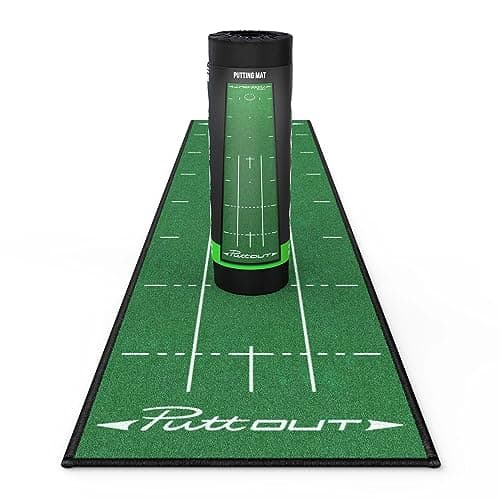
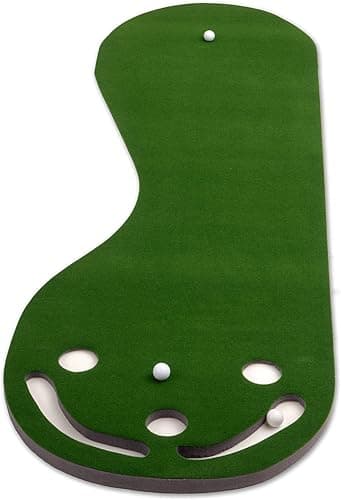
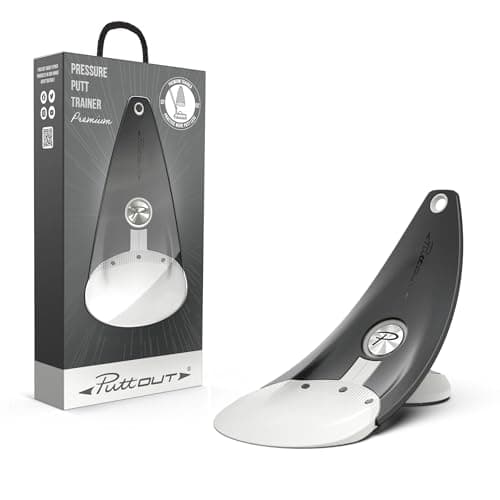
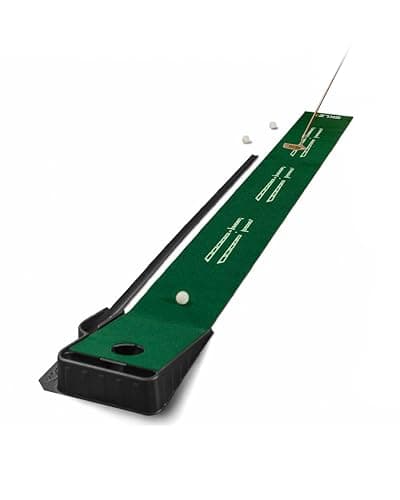
The SKLZ Accelerator Pro is the best putting mat under $100: nine feet long, with distance guides at three, five and seven feet and a gravity ball return that sends every putt back to you, so a thirty-minute session is thirty minutes of putting rather than twenty minutes of walking. If you care more about the surface than the length, the PuttOUT Medium is the one mat here with a published green speed. Our budget pick is the Putt-A-Bout Par Three — the cheapest way to putt at an actual hole indoors. And the PuttOUT Pressure Putt Trainer, listed last, is not a mat at all: it is the thing to add once you own one. Every price in the table above is live and carries the date it was checked; the $100 ceiling is applied to that feed.
Our hub's main best putting mats page ranks the whole field, including two mats at around a hundred and fifty dollars. This page applies the ceiling most people are actually shopping under and it changes the shape of the answer: once the two premium mats come out, the question becomes length against surface speed, and those pull in opposite directions.
Why a putting mat is the best value in golf equipment
Putting is the only part of golf you can practice properly at home, in socks, in the dark, in February. It is also the part where amateurs lose the most shots to the simplest cause: pace. Nobody three-putts because they misread the break on a six-footer. They three-putt because the first putt finished eight feet past or six feet short.
A mat fixes pace specifically, because it holds the surface constant. Every other variable in golf practice moves around; a mat does not. That is why our budget putters page says outright that thirty minutes a week on a mat does more for your scores than any putter upgrade, and why the Odyssey entry on that page says the same thing about itself.
Length versus speed: the real trade under $100
Length is how far back you can stand. Nine feet lets you work a putt long enough to matter; six feet turns every stroke into a tap-in. Both the SKLZ and the Putt-A-Bout are nine feet.
Speedis how fast the surface rolls, measured on a Stimpmeter. As Haggin Oaks explains it, the Stimpmeter measures how far a ball rolls off a standard ramp, and typical daily play sits well below tournament speed. PuttOUT publishes its Medium mat at 10 on the Stimpmeter, which is firm daily-play-to-quick territory — and it is the only mat here with a published number at all. The others do not state a speed, so we do not print one.
Why it matters: if your mat rolls much slower than your course, you groove a stroke that hits putts too hard, and you spend the first three holes of every round running the ball past the hole. A fast mat teaches you a stroke that transfers. A long mat gives you more distances to practice. Under $100 you largely choose one.
Ball return is not a gimmick
It is the feature that decides whether you practice. The SKLZ Accelerator Pro uses an up-slope cup and a gravity return channel that sends the ball back down the mat to your feet. In a twenty-minute session that is the difference between roughly forty putts and roughly a hundred and twenty. Nothing else on this page affects repetition count as much.
The Putt-A-Bout takes the opposite approach: three real cups in a nine-by-three kidney shape with sand-trap cutouts at the back that catch the misses so you are not chasing balls across a room. No return, but three holes and three breaks.
Published specs, side by side
| Mat | Size | Published speed | Ball return |
|---|
| SKLZ Accelerator Pro | 9 ft x 16.25 in | Not published | Gravity return, up-slope cup |
| PuttOUT Medium | 7.9 ft x 1.6 ft (240 x 50 cm) | Stimp 10 (PuttOUT published) | No |
| Putt-A-Bout Par Three | 9 x 3 ft kidney | Not published | No (sand-trap cutouts catch misses) |
| PuttOUT Pressure Putt Trainer | Target, not a mat | n/a | Returns the ball its past-the-hole distance |
The trainer, and why it is listed here
The PuttOUT Pressure Putt Trainer is a parabolic ramp instead of a hole. A putt with perfect pace is returned to you the same distance it would have finished past the cup; a putt too hard flies off the top; a micro-target at the tip only holds a putt struck at the eighteen-inches-past pace that coaches teach. It turns any flat surface into a pace drill, folds flat and fits in a bag pocket.
It is the best thing on this page per dollar, and it is not a mat — it needs a true, consistent surface to be worth anything, which is exactly what the three mats above provide. Buy a mat first, then add it.
What we left off, and why
The two mats in our catalog at around a hundred and fifty dollars — a nine-and-a-half-foot practice green and a ten-foot mat with a published drill programme — are both better products and both over the ceiling this page sets. A page with a number in the title has to respect the number, so they stay on the main putting mats page. We also do not rank any mat whose only stated spec is a size, because under $100 the thing you are actually buying is surface consistency, and a listing that will not describe the surface is not describing the product.