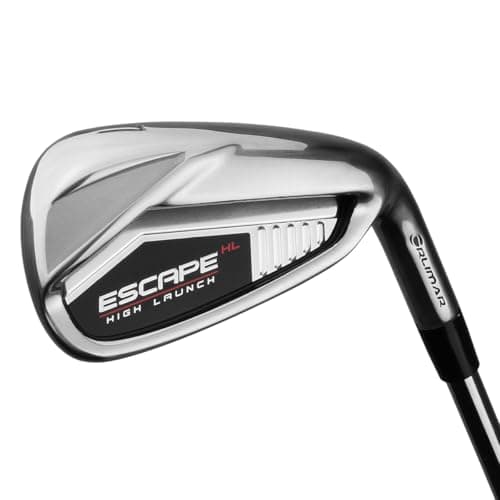
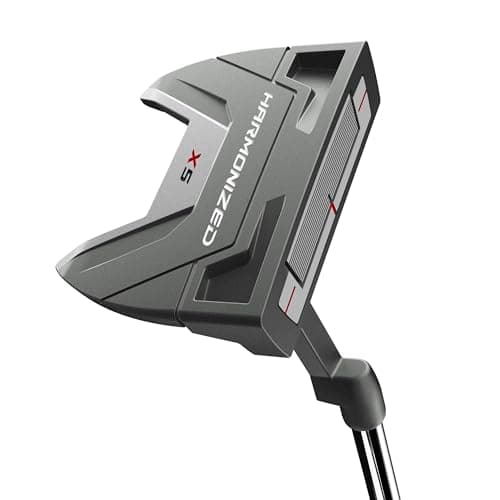
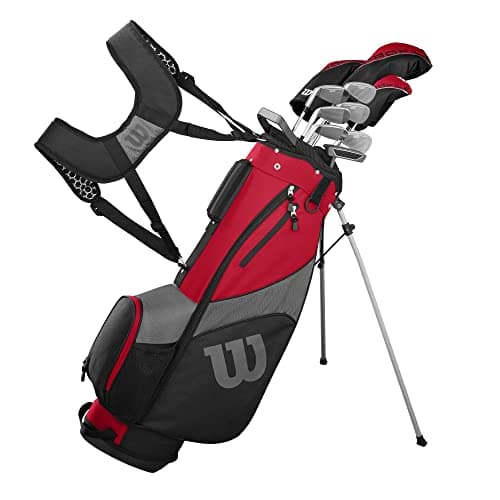
If you are between about 5'6" and 6'1", standard-length clubs are almost certainly right for you and nothing on this page should make you spend money. The rule of thumb worth knowing is roughly an inch of extra length for every six inches you are over 5'9" — so a 6'3" to 6'6" golfer is the one who should genuinely be looking at plus-one-inch clubs.
What "standard length" actually is
Standard is not one number, it is a set of them. BirdieBall's published sizing guidance puts the baselines at:
| Club | Standard length |
|---|
| Driver | 43–45 in |
| Fairway woods | 41–43 in |
| Irons | 36–40 in, descending through the set |
| Wedges | 35–36 in |
| Putter | 33–35 in |
Every off-the-rack set and every boxed package set — including the ones we rank on best golf sets for beginners— is built to those numbers in a men's standard. Women's sets are built roughly an inch shorter, which is a length decision as much as a flex one and is covered in women's vs men's clubs. Junior sets are sized by the child's height directly, which is the one case where height really is the governing measurement — see best junior golf clubs.
Why height is the wrong measurement
Two golfers of identical height can need different club lengths, because what determines how far your hands sit from the ground is not your total height — it is the length of your arms relative to your torso and legs. A tall golfer with long arms may play standard length perfectly; a shorter golfer with short arms may need the same clubs as somebody four inches taller.
The measurement fitters actually use is wrist-to-floor: stand upright in your golf shoes, arms hanging naturally, and measure from the crease of your wrist to the floor. It is the single number that, combined with height, drives both club length and lie angle in every manufacturer fitting system. If your wrist-to-floor is long for your height, you need less added length than the height rule suggests — and vice versa.
The two-minute self-check
- Put your golf shoes on and stand on a hard floor. Shoes change the answer by half an inch.
- Let your arms hang completely relaxed. Do not reach down and do not shrug up; have somebody else take the measurement if you can.
- Measure from the crease on the inside of your wrist to the floor, in inches. Write it down alongside your height.
- Then do the thing that matters more than either number: take a 7-iron, address a ball on grass, and look at the sole. If the toe sits up off the ground your clubs are too upright or too long for you; if the heel sits up they are too flat or too short. A strip of impact tape on the sole after five shots on a mat tells you the same thing in black and white.
That last step is why we are not going to publish a height-to-length table that pretends to be a fitting. The strike mark on the sole of a club you already own is better evidence than any chart, and it is free.
What getting it wrong actually does
Length and lie interact. Clubs that are too long for you tend to sit too upright at address, which pushes the toe up and turns the face left of where you aimed — a pull or a hook for a right-hander. Clubs too short sit too flat, heel up, pushing shots right. Length also moves your posture: too long and you stand up and swing flatter; too short and you crouch and get steep, which is how fat shots start.
The honest size of the effect: for a golfer within a few inches of average height, it is small compared with the strike quality that dominates amateur golf. For a golfer at 6'4" or 5'2" playing men's standard clubs, it is not small at all, and it is the cheapest real improvement available.
Cheap fixes before you pay for custom
- Shaft extensions. A clubfitter can extend an existing iron set by up to about an inch for a few dollars a club plus regripping. Far cheaper than a new set, and the standard answer for a tall golfer who already owns clubs.
- Cutting down and re-gripping. The same operation in reverse for a shorter golfer. Note that shortening a club stiffens its shaft slightly, so if you are already at the soft end of your flex, read what shaft flex you need first.
- A bend for lie angle. Most cast irons can be bent a couple of degrees upright or flat. Often the real fix when a length change was only ever a proxy for a lie problem — and how much a fitting helps puts a number on what that is worth.
- Grip size, for the hands. A grip two sizes too small makes a tall golfer with large hands over-rotate the club. Building up a grip with extra wraps of tape costs almost nothing, and our grip page ranks the value options.
- Pick the putter length at purchase. This is the one club where length is a specification you choose when you buy, not an adjustment you make later. 34 inches is the common standard; shorter golfers are usually better at 33.
So should you deviate from standard?
Our position: buy standard unless you are outside roughly 5'5" to 6'2", or unless the sole of your 7-iron is visibly telling you otherwise. If you are a beginner, buy standard regardless and revisit it once your swing has settled — a first set bought to custom specs is money spent fitting a swing that will not exist in a year, which is the same argument as in how much to spend on a first set. If you are genuinely tall or short, an extension or a cut-down on a value set gets you 90% of the benefit of a custom build for a tiny fraction of the money, which is exactly how this site thinks about every other category too.