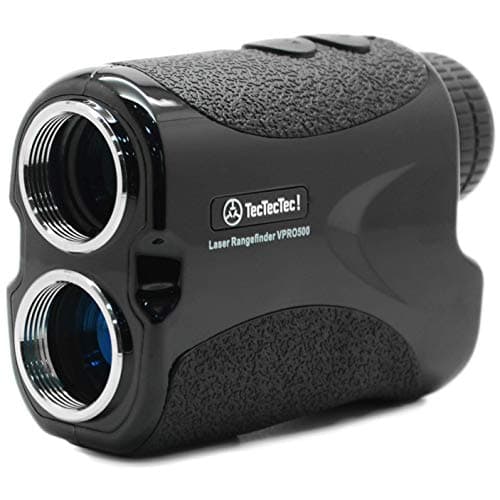
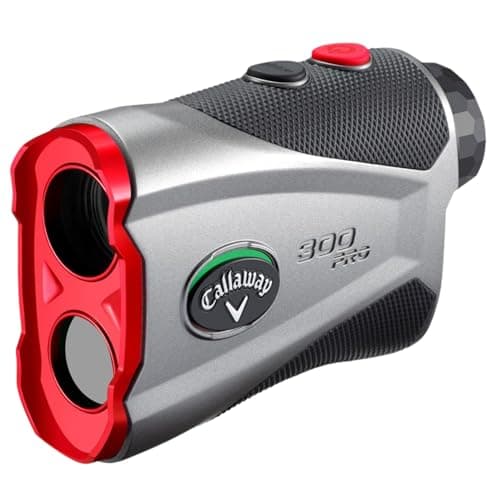
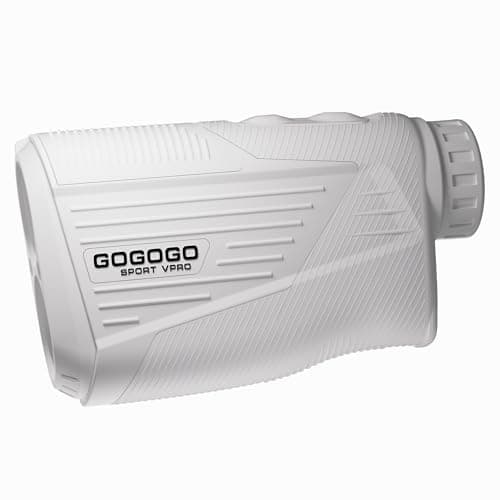
The whole skill is this: brace the device against something, put the reticle on the flag rather than the trees behind it, and wait for the confirmation — the vibration or pulse that tells you the laser locked the nearest small target rather than the hillside beyond it. Everything else on this page is a setting you check once. If you are buying your first one, the Gogogo Sport Vpro has pin-lock vibration and a slope switch for the least money, which are the two features that matter on day one.
Step by step, on the tee
- Steady the unit. Rest your elbows on your chest, or brace against a cart post or the top of your bag. A laser beam is narrow, and hand shake at 180 yards is what puts the dot on the tree line.
- Find the flag with both eyes first, then raise the device to that spot. Hunting for a flag through 6x optics is how golfers hold up the group behind.
- Hold the button and sweep gently across the pin. Most units read continuously while the button is held, so a slow horizontal sweep across the flagstick is far more reliable than trying to hold perfectly still on it.
- Wait for the confirmation.A short vibration or pulse means the device has locked a near target — that is the pin. No buzz and a suspiciously long number means you have ranged whatever is behind the green.
- Sanity-check against the course. If the card says 150 and your device says 173, you have the back of the green or the tree line. Range again.
The three settings most golfers never find
- Slope, and its switch.Slope adjusts the number for elevation change and is genuinely useful on a hilly course. It is also not allowed in competition unless it can be disabled: under the Rules of Golf a distance-measuring device must not be used to gauge elevation change, which is why every slope rangefinder worth buying has a physical switch or shift. Learn where yours is before your first competitive round — do I need slope on a rangefinder covers whether to pay for it at all.
- The diopter.The eyepiece rotates to focus the display for your eyes. If your reticle looks soft, it is not a faulty unit, it is an unset diopter — and a soft reticle is the single most common reason golfers think a cheap rangefinder is inaccurate.
- Yards or metres. Obvious, and still the cause of an alarming number of three-putts. Check it on the first tee of a trip abroad.
What the numbers are telling you
A rangefinder gives you a straight-line distance to whatever it hit. That is not the same as the number you should club off. Three adjustments turn one into the other: the pin position on the green (front, middle or back), the elevation change if slope is off, and the wind. Pros play a number; amateurs usually play the yardage to the flag and come up short, because the flag is rarely in the middle and almost nobody flushes it.
The honest way to use the device is as a reality check on your own distances rather than a precision instrument. If your tracked 7-iron goes 146 yards and the laser says 158, the laser has told you to hit a 6-iron. Our golf club distance chartis the other half of that equation — a yardage is only useful if you know what your clubs do.
Four habits that cause bad readings
- Ranging through rain or fog, which scatters the beam and shortens the effective range.
- Ranging through a flag that is hanging dead still against a dark tree line, where there is no contrast for the optics.
- Leaving the lens smeared with sunscreen, which is the most common cause of a device that “stopped working”.
- Letting the battery sit flat for a season; a weak battery gives slow locks and inconsistent reads rather than failing outright.
Pace of play, and the etiquette bit
Range while others are playing, not when it is your turn. Get your number as you walk to your ball, and make the device a four-second job rather than a ritual. The fastest users keep the unit magnetised to the cart frame or clipped to the bag strap, which is why a magnetic strip is a feature worth having on a cheap model.
And if you are still deciding between a laser and a watch, the devices answer different questions — rangefinder vs GPS is the page for that, while the best rangefinders under $200 is where to shop once you have settled on a laser.