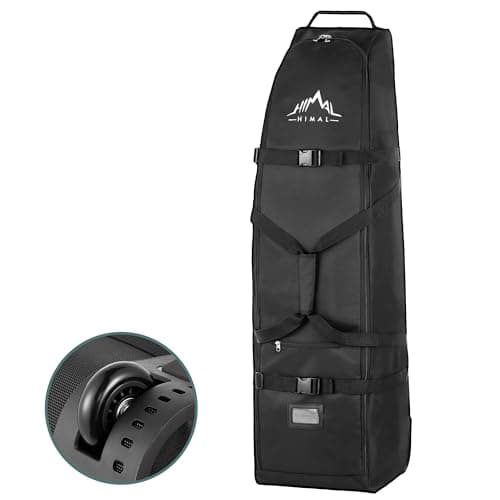
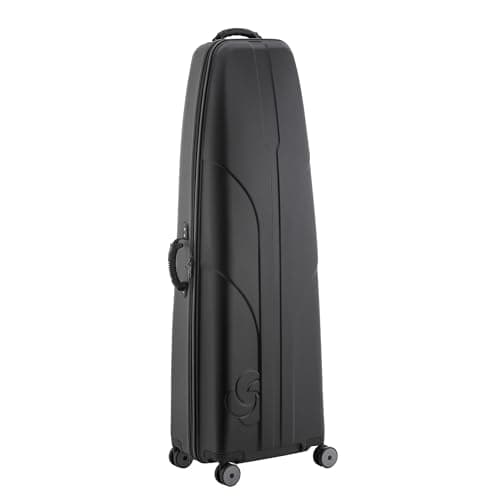
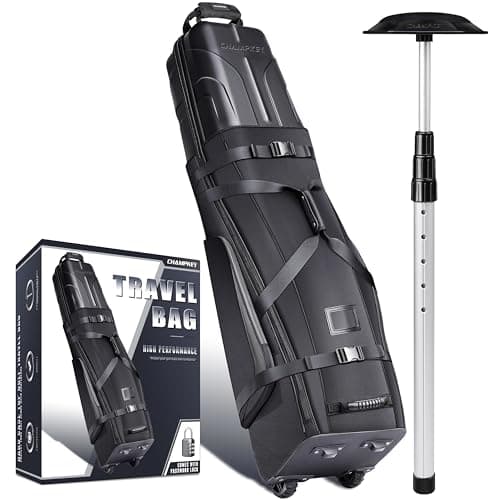
No, the major US airlines do not charge a special golf fee. On Delta, Southwest and Alaska — the three carriers whose published policies we read for this page — a golf bag is treated as one standard checked bag, and several of them waive the oversize fee that a 50-inch travel case would otherwise trigger. What does cost money is weight. The 50 lb line is where a free-ish golf trip turns into an excess-baggage charge, and the fastest way over it is treating the travel cover as spare luggage space.
The second cost is not a fee at all. Both Delta and Southwest publish the same condition for soft-sided covers: your clubs go in the hold under a limited release of liability, which means damage is on you. That single clause is the strongest argument for a hard top that exists, and it is written on the airlines' own pages rather than on a travel-bag brand's.
What the carriers actually publish
Everything in this table was read from the airline's own page on 17 October 2026. Baggage pricing moves constantly and the dollar amounts are the part most likely to change, so treat this as the shape of each policy and confirm the current fee with your carrier before you fly.
| Carrier | How a golf bag is treated | Hard limits it publishes |
|---|
| Delta | One golf bag per passenger as a standard checked bag; counts toward your checked allowance, standard charges apply | Overweight fee over 50 lb; not accepted over 115 linear inches; not accepted at 100 lb or more |
| Southwest | Standard checked bag fees and overweight bag fees apply — but oversize fees are waived | Not accepted over 100 lb and/or 115 inches total dimensions |
| Alaska | Golf clubs are on the sports-equipment list; Alaska has published a flat $30 first-bag sports-equipment rate, and the equipment counts toward the free checked allowance for elite, First Class, Club 49 and Alaska Visa cardholders | Oversize and overweight fees waived for listed sports equipment, provided it is packed in a case designed specifically for that equipment |
United and American publish their own sports-equipment policies and both are widely reported to treat golf clubs the same way. We could not load either carrier's official page while writing this, so we are not going to put numbers in their names — check united.com and aa.com directly. The pattern across every US carrier we could verify is the same: a golf bag is a checked bag, and the exceptions run in the golfer's favor.
What Delta says one golf bag may contain
This is the detail that catches people out, because it is narrower than most golfers assume. Delta defines one checked golf bag as: one golf bag, one set of golf clubs, golf balls and tees, and one pair of golf shoes. Clubs must travel in a hard-shell case, or in a soft-sided golf travel bag after you sign a limited release.
Note what is not on that list: clothing, a second pair of shoes, a rangefinder, a cooler, a week of laundry. Stuffing those into the travel cover is the single most common way a golf bag goes over 50 lb, and the airline is entitled to treat a case packed with general luggage as general luggage. Southwest's policy is written the same way — golf bags provided by the passenger, including clubs, balls and shoes.
The 50 lb line, and how to stay under it
Nothing on this page will save you more money than a bathroom scale the night before you fly. The method is crude and it works: stand on the scale holding the packed travel case, then stand on it alone, and subtract. If you are within a couple of pounds of 50, take something out — because airport scales are not calibrated in your favor and the overweight charge is per bag, each way.
Three things that quietly add weight most golfers forget about:
- The case itself. A hard shell is heavier than a soft cover before you put a single club in it. That weight is a real trade against the protection it buys, and it is the main argument for the soft option if you are a once-a-year traveler.
- A full bag of balls. A dozen balls is about a pound and a half. Three dozen rattling around in the ball pocket is five pounds you could have bought at the destination for the same money.
- Shoes and a jacket stuffed into the spare space. Tempting, free-looking, and the reason the scale reads 53.
Our how to pack golf clubs for a flight guide covers the rest of the method, including the stiff-arm question and why the driver head is the part that actually breaks.
The limited release: the clause that should decide your case
Read these two published conditions together.
Delta: clubs must be in a hard-shell case, or in a soft-sided golf travel bag after you sign a limited release, and Delta states it is not responsible for damage noted at check-in or damage caused by over-packing.
Southwest: hooded bags and soft-sided carrying cases are accepted, but under a limited release of liability, and customers are not eligible for reimbursement or compensation for damage that occurs where that limited release applies.
In plain terms: if you fly a soft cover and the airline snaps a shaft, you have no claim. That is not a scare story from someone selling hard cases — it is the carriers' own published position. Whether it matters depends entirely on what is inside. A budget package set in a soft cover is a sensible risk. A fitted driver and a set of irons you saved for, in a thin soft bag with no stiff arm, is not. We lay out both sides on hard vs soft golf travel bags.
The 115-inch ceiling nobody mentions
Both Delta and Southwest publish an absolute cap: nothing over 115 linear inches (length + width + height) and nothing at 100 lb or more is accepted as checked baggage at all. A standard golf travel case is nowhere near either limit — a typical universal cover is around 50 inches long, which lands comfortably inside 115 linear inches once you add the other two dimensions. It is worth knowing because it is the one rule that is not a fee: over that line, the bag does not fly, and no amount of paying fixes it.
So what should you actually do?
- Check your own carrier's sports-equipment page on the booking you hold, not a summary site. Fees differ by cabin, route and status, and they change.
- Expect to pay a normal checked-bag fee, and nothing extra. If a carrier quotes you a special golf charge, that is unusual among US carriers and worth querying.
- Weigh the packed case at home. 50 lb is the number; the night before is the time.
- Decide hard or soft on the value of the clubs,not the price of the case — because the liability waiver, not the fee, is the real cost of flying with golf clubs.
If you are shopping for the case itself rather than reading the rules, our best golf travel bags roundup ranks the field on protection per dollar, and how long golf bags lastcovers the failure modes that air travel accelerates — wheels and zips first, always.