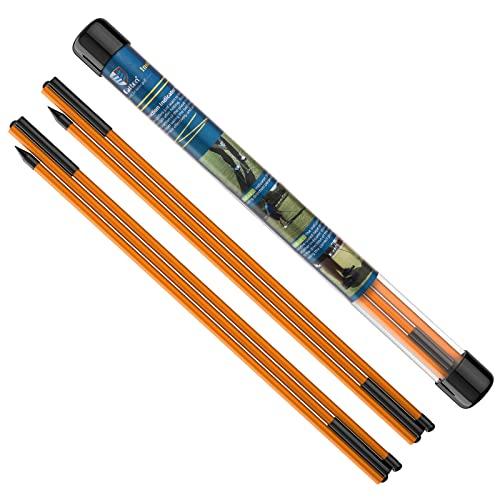
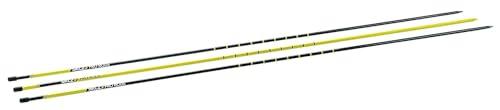
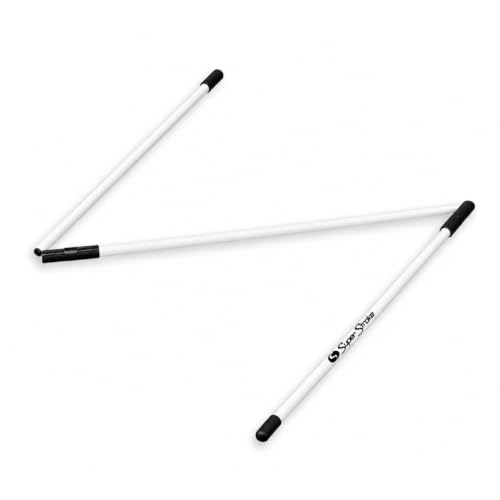
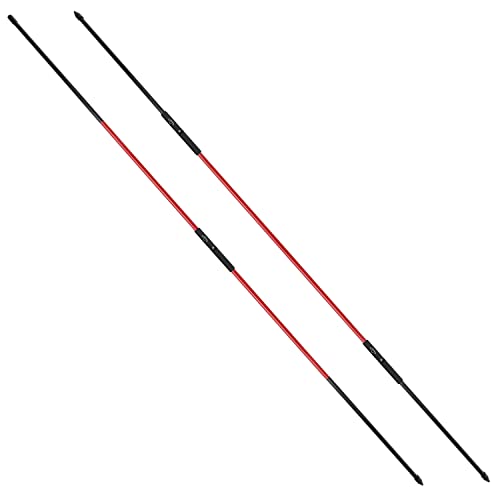
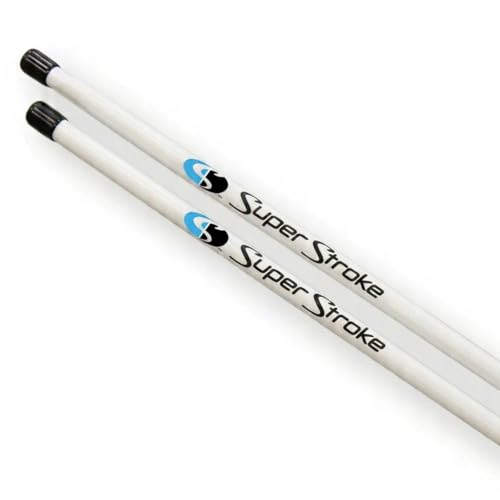
The SuperStroke 45 in fiberglass pair is the best alignment-stick buy for most golfers: it publishes a real length and a real material, it is one piece so it is dead straight, and it is stiff enough to stand in the turf for a gate drill. Our budget pick is the MoKo 48 in collapsible set, which states the longest length on this page and folds into a tube that fits a bag pocket — for a fraction of the money. The SKLZ set is the one to buy if you run structured drills, because the third stick is the one you end up wanting. Prices in the table above are live and date-stamped.
Start with where you are allowed to use them
This is the part that decides which stick you should buy, and it is almost never mentioned in a roundup. An alignment stick is a practice tool, not a playing tool, and the Rules of Golf say so in two separate places.
Under Rule 4.3a, in the section covering distance and directional information, the Rules list as not allowed “using an alignment device… to help align the ball.” Then Rule 4.3a(6), which covers stretching devices and training or swing aids, says using a training or swing aid is not allowed where it creates a potential advantage by helping with preparation or the stroke — and the Rule's own examples of that are “an alignment rod or a weighted headcover,” used for “swing plane, grip, alignment, ball position or posture.”
There is exactly one carve-out, and the Rule names the stick in it: general stretching is allowed “other than in making a practice swing,” and the example given is “an alignment rod placed across the shoulders.” So the stick in your bag is legal to stretch with on the first tee and not legal to lay on the ground to check your aim. That is the whole on-course story.
The second place it bites is before the round. Under Rule 5.2b, in stroke play a player “must not practise on the course before a round,” with exceptions for putting or chipping on or near the first teeing area and for any practice area; the penalty is the general penalty on the first hole for a first breach and disqualification for another. (Match play is different — Rule 5.2a allows practice on the course before or between rounds, and a Committee can change either by local rule.) In plain terms: the sticks belong on the range and on the practice green, which is where every serious user has them anyway.
Why does that change the purchase? Because a stick that lives on a range mat can be as long and as rigid as you like, and a stick that has to travel to a range in a stand bag cannot. Everything below follows from that one trade.
How we picked these
- Published length.Length is the one spec that changes what the stick can show you, and most listings in this category do not state it. Two of our five do — 45 in and 48 in — and they are ranked first and second partly for that reason.
- One piece or sections. A one-piece rod is straight and can be pushed into turf. A folding or sectioned rod flexes at the joints and cannot be stood up under load. This is the real split in the category and it is not a quality difference, it is a design choice.
- Does it fit the bag? A stick you leave at home has an effectiveness of zero. Packability is scored as heavily as stiffness here, because habit beats specification.
- What is in the box. Two sticks covers aim. A third covers ball position or a swing-path gate. A tube case is the difference between sticks in a pocket and sticks rolling around a trunk.
- No invented specs.Three of these five listings publish no length, diameter or material at all. Where nothing is stated, we say so rather than filling the gap — and we score the silence.
Length: why 45 to 48 inches, and not 40
A shorter stick is cheaper, packs smaller and is genuinely fine for the simplest use: lay it down on your target line, stand parallel to it, hit balls. The length starts to matter the moment you want the stick to do two jobs at once.
A 48 in rod laid on the target line runs past the ball far enough that you can still read the line while standing behind the ball, which is how you actually check aim. It also reaches far enough to form a usable gate when crossed with a second stick. At 40 in you are working with a line that stops near your feet — perfectly good for a foot-line reference, less good for everything else. That is the honest case for paying more, and it is also why the cheapest stick on this page is the longest: MoKo states 48 in, which no other listing here beats.
The thing nobody publishes is diameter, and it matters for one specific drill: a stick you intend to push into firm ground needs to be thick and stiff enough not to bow. None of the five publishes a diameter. Fiberglass construction, which the SuperStroke 45 in set does state, is the nearest thing to a proxy.
One piece versus collapsible: the whole decision
Every stick here is one of two products wearing the same name.
- One-piece rods (SuperStroke 45 in, SKLZ, and the Callaway in its rigid half) are dead straight, do not flex in the middle, and can be driven into turf so they stand up. They do not shorten. A 45 in rod rides diagonally in a trunk or sticks out the top of a bag, and plenty of golfers quietly stop carrying them for exactly that reason.
- Collapsible or folding rods (MoKo, SuperStroke Tri-Fold) break into sections or fold in three, and the whole point is that they fit a bag pocket. The trade is at the joints: sections can sit a degree or two off-straight, and they are the weak point under any side load. For laying a line on the ground, that difference is invisible. For a stick standing vertically in the ground, it is the failure mode.
So the honest advice is unusual for a value site: buy on your habits, not on the price. If your practice happens at a range you drive to and you own a car trunk, the rigid pair is better and the money is small either way. If the sticks have to live in the bag or they will not come, buy the collapsible pair and stop worrying about the joints.
Two sticks, three sticks, or a hinge
Two sticks is the standard set and it covers the two references most golfers need: one on the target line and one along the toes. The third stick is what the SKLZ set adds, and it is the one that turns a static aim check into a drill — perpendicular across the line to fix ball position, or raised on a couple of range baskets as a swing-plane reference.
The Callaway Hinge Stix is the odd one out and deserves a straight explanation. It hinges, so part of the stick goes into the ground and part of it stays on the line, which gives you the vertical reference people normally improvise with a propped-up headcover. It is a genuinely clever answer to a specific drill. It is also a moving part in a product whose entire job is being rigid, it costs more than a plain pair, and Callaway's own training-aid pages did not list this model when we checked — so we rank it last and label it as a current retail listing rather than a catalog fixture. If you want a target line and nothing else, skip it.
Published specs, side by side
| Pick | Sticks | Length published? | Construction |
|---|
| SuperStroke 45 in fiberglass | 2 | Yes — 45 in | One piece, fiberglass (stated) |
| MoKo collapsible | 2 sets | Yes — 48 in | Sectioned, tube case |
| SKLZ 3-stick set | 3 | No | One piece |
| SuperStroke Tri-Fold | 2 | No | Folds in three |
| Callaway Hinge Stix | Hinged stick | No | Hinged, ground-insert |
Three of the five publish no length at all, and none of the five publishes a diameter or a weight. That is the honest state of this category: it is a commodity bracket where the brands behave like the no-name sellers. It is also why we weight a stated spec as heavily as we do — a number you can read is a number you can hold a seller to.
What alignment sticks do not fix
Sticks fix the fault you cannot see and can correct alone: aiming somewhere other than where you think you are aiming. They do nothing for the faults you can feel. A stick will not change your strike quality, it will not slow your transition, and laying one on the ground will not stop a slice on its own — if the clubface is open at impact, a perfectly aimed body just posts the ball further right.
That is why the sticks are the first purchase and not the only one. Our best golf training aids page ranks the wider field, including the 40 in collapsible pair that wins it on price alone, plus the impact and tempo trainers that work on the parts of the swing a stick cannot reach. If the problem is specifically a ball starting right and curving further right, our best anti-slice drivers page deals with the equipment half of it honestly.
Where you will actually use them
Three places, and the stick you buy should suit whichever one is yours. On a range mat, anything works — and if you are hitting off a mat at home, the mat matters more than the stick, which our best golf hitting mats page covers. In a net at home, a long rigid stick is the better buy because nothing has to travel; our practice nets and mats page is the setup guide for that. On the practice green, the stick is for a putting-path reference and you would often rather have a dedicated surface, which is what the best putting mats ranking is for.
What we would actually buy
The SuperStroke 45 in fiberglass pair if your practice happens somewhere you drive to: the length and the material are stated, it is straight, and it stands up in turf. The MoKo 48 in collapsible set if the sticks need to live in the bag — it is the longest stated length here and costs a fraction of everything else, which is the trade this site exists to point out. Add the SKLZ three-stick set only if you genuinely run drills with a ball-position reference.
And keep the scale in mind: this is the cheapest meaningful purchase in golf. A pair of sticks costs less than one round of range balls a month, and alignment is the one fault an amateur can diagnose and fix without a coach. If you have twenty dollars and a decision to make, this beats almost anything else you could spend it on — including, for most golfers, the next dozen balls off our best golf balls for the money page.